


KOSPI drops by half from its peak, with market capitalization shrinking by approximately 3,600 trillion won; the impact on household assets must be confronted.
Citi estimates 563 trillion won in household stock capital losses for the second half of the year, warning of a potential contraction in consumption.
The government must move beyond rhetoric and respond with concrete execution.
The sheer numerical decline of the stock index fails to capture the gravity of the current crisis. The assets that citizens have painstakingly accumulated are evaporating, putting funds intended for marriage, housing, and retirement at risk. For young people just starting to build their wealth, this erosion of principal is not merely a dip in returns; it is a fundamental destabilization of their future.
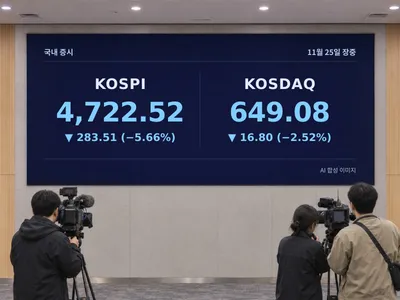
On the 25th, the KOSPI closed at 4,697.51, down 6.16% from the previous trading day. Compared to its all-time high of 9,114.55 on June 22, the index has fallen by 48.46%. The KOSPI's market capitalization, which once reached 7,400 trillion won, has shrunk to around 3,800 trillion won. In just five months, approximately 3,600 trillion won in market value has vanished.
The scale and speed of this decline are too severe to be dismissed as a mere correction following a steep rally. The government and the ruling party must answer a clear question: what measures will be taken to stabilize a market gripped by extreme fear, and how will they restore shattered confidence? If they claimed credit for the market's rise as a political achievement, they must now demonstrate corresponding responsibility and a robust response to the shock citizens are enduring.
Double the Decline of Taiwan: Household Losses of 563 Trillion Won Threaten the Broader Economy
While global markets are undergoing adjustments due to concerns over AI over-investment, the decline in the Korean market is particularly pronounced.
As of the 25th, the 52-week peak-to-trough declines for the Taiwan Weighted Index and Japan's Nikkei 225 were 23.67% and 21.59%, respectively. The U.S. S&P 500 and Nasdaq saw declines of 8.20% and 14.25% as of the 24th. The KOSPI's decline is more than double that of Taiwan and Japan. Given that Taiwan is also a semiconductor-centric market, this cannot be explained away as a global trend alone; domestic supply-demand structures, investment foundations, and policy vulnerabilities must be scrutinized.
There are few places to hide within the market. According to FnGuide, as of the 23rd, none of the 10 major domestic industry sectors recorded positive returns for the month. Beyond IT and semiconductors, even defensive sectors like consumer staples and healthcare have turned negative.
A report by Kim Jin-wook, chief economist at Citibank Korea, estimates that Korean households will face approximately 563 trillion won in stock capital losses in the second half of this year. This estimate suggests that most of the capital gains households achieved during the first-half rally may have been wiped out.
More concerning is that these losses are not confined to brokerage accounts. Citi estimates that the decline in stock asset values will reduce private consumption by approximately 8.4 trillion won, warning that weakened household spending power could weigh on economic growth through next year.
Foreign selling pressure is also intense. As of the 23rd, foreign net selling in the KOSPI market reached 254.8 trillion won this year, with 84% concentrated in Samsung Electronics and SK hynix. For individual investors, the situation is equally dire; analysis from Korea Investment & Securities shows that as of the 19th, 56% of Samsung Electronics investors and 75% of SK hynix investors were in a loss position.
Taiwan Deploys Stabilization Funds and Short-Selling Curbs; When Will Korea Act?
Taiwan approved the activation of its National Financial Stabilization Fund on the 6th and implemented market stabilization measures on the 9th. It also tightened short-selling regulations. In contrast, while Korean financial authorities have temporarily exempted securities firms from certain collateral maintenance obligations and eased rules on corporate share buybacks, the actual deployment of the Stock Market Stabilization Fund remains uncertain.
The current committed capital for the Stock Market Stabilization Fund is 10.76 trillion won—an amount roughly equivalent to what foreign investors sold in just five days earlier this month. The fund represents less than 0.3% of the current KOSPI market capitalization. Furthermore, this is not cash readily available; it operates on a capital-call basis, and administrative procedures for its use remain pending.
Park Hyeon-joo, Chairman of Mirae Asset Group, stated in an interview on the 25th that the market crash is driven by a liquidity crunch and suggested that the stabilization fund needs to be expanded to at least 100 trillion won. While policy alone cannot explain the divergence in market performance, the government must clarify whether its stabilization measures are sufficient and ready for execution. If the decision is not to deploy them immediately, the rationale and principles for future intervention must be clearly communicated to the market.