

Shipbuilding index halved this year; defense and nuclear sectors also plummet
Slowing orders, contract delays, and earnings lags shake expectations for future growth
Multi-year backlogs have been the core pillar supporting the stock prices of South Korea's shipbuilding, defense, and nuclear power companies. Secured contracts provided visibility into future revenue, while global supply chain restructuring and heightened national security concerns fueled expectations for additional orders.
The recent sharp decline in these stocks indicates that market focus is shifting from existing backlogs to future growth. Beyond immediate earnings, concerns over potential declines in new orders and delays in major contracts are challenging the premises that previously supported high valuations.
As of the 26th, the KRX Shipbuilding TOP10 Index and the KRX K-AI Defense TOP5+ Index have fallen by 51.75% and 28.89%, respectively, since the beginning of the year. Major domestic nuclear power exchange-traded funds (ETFs) have also recorded declines of 57% to 60% over the past six months.
Shipbuilding Industry Overflowing with Work, Yet Merchant Vessel Orders Expected to Decline Next Year
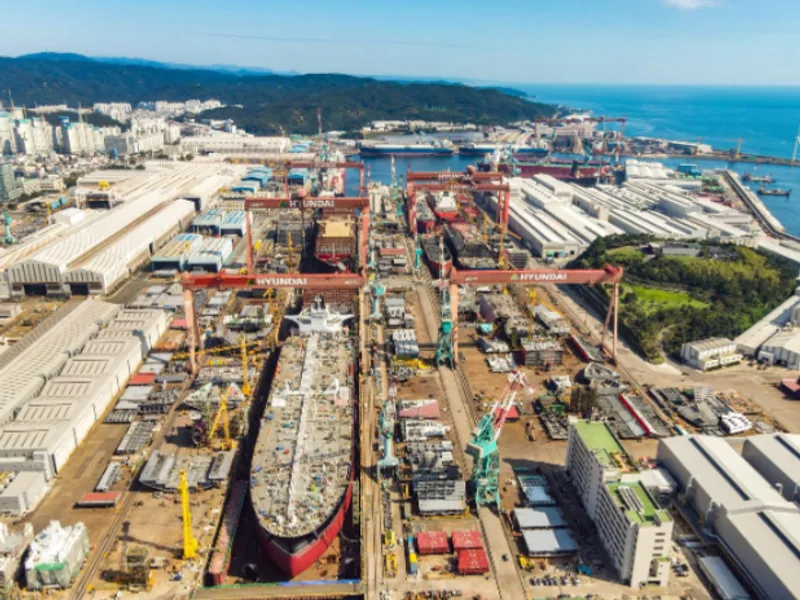
The shipbuilding industry shows the most distinct gap between stock performance and operational reality. The combined shipbuilding and offshore order backlogs for HD Korea Shipbuilding & Offshore Engineering, Samsung Heavy Industries, and Hanwha Ocean reached approximately 139 trillion won at the end of September. Profitability is also improving as ships contracted at higher prices in the past are now being reflected in revenue.
The combined new orders for the three major shipbuilders this year have already surpassed their annual performance from last year. This makes the recent decline in shipbuilding stocks difficult to explain solely by sluggish orders or deteriorating industry conditions.
Due to the nature of the shipbuilding industry, where construction takes years, current earnings reflect past market booms, while stock prices react first to future ordering conditions. If global order volumes shrink while the Chinese shipbuilding industry expands its production capacity, the pricing power of domestic shipbuilders could weaken.
Lee Han-gyeol, an analyst at Kiwoom Securities, noted, "A 20-30% decline in new merchant vessel orders in 2027 compared to 2026 is inevitable," while highlighting the importance of whether U.S.-led liquefied natural gas (LNG) carrier orders will resume.
While domestic shipbuilders maintain a strategy of selective, profitability-focused orders, Chinese firms are accumulating experience in building large vessels and expanding production capacity. Avoiding low-price competition is a different issue from the shrinking of the high-value market itself.
Global Military Spending Rising, Yet Major K-Defense Contracts Lag
In the defense industry, changes in order backlogs have emerged as anticipated new contracts face delays.
The combined defense-related order backlogs of the four major companies—Hanwha Aerospace, Korea Aerospace Industries (KAI), LIG Defense & Aerospace (formerly LIG Nex1), and Hyundai Rotem—fell from 101.3 trillion won at the end of last year to 95.3 trillion won at the end of September.
As of October this year, overseas arms export contracts worth over 100 billion won signed by the domestic defense industry totaled approximately 4.4 trillion won, only a quarter of last year's annual contract value.
While backlogs can temporarily decrease as deliveries of existing contracts begin, the failure to secure follow-up contracts to fill the void makes it difficult for current production expansion to translate into mid-to-long-term profit growth.
Although military expansion in Europe and the Middle East remains a favorable environment for the domestic defense industry, complex negotiations regarding export financing and local production conditions remain before actual weapon procurement decisions are finalized.
Kiwoom Securities cited the delay of large-scale projects in the second half and earnings adjustments due to a stronger won as primary factors for the decline in defense stocks. The firm expects that whether ongoing overseas projects lead to actual contracts next year will determine the mid-to-long-term earnings outlook.
Nuclear Power Construction Competition Intensifies; When Will Equipment Orders Follow?
Expectations surrounding the performance of nuclear-related companies also need to be backed by concrete contracts.
New orders for Doosan Enerbility's core energy division reached nearly 10 trillion won between January and September this year. However, this includes performance from other power generation equipment businesses, such as gas turbines, and cannot be viewed solely as growth from the nuclear power business.
Even when nuclear construction plans are announced, they must go through financing, licensing, and contractor selection before leading to actual equipment orders. The share that domestic companies can secure in power plant construction projects varies by project.
JPMorgan recently highlighted whether U.S. nuclear operators will place early orders for equipment in its strategy for the Korean industrial sector. This is because orders for core equipment with long production lead times must begin for domestic companies to estimate the timing and scale of revenue generation more accurately.
The simultaneous decline in shipbuilding, defense, and nuclear power should not be viewed solely as a weakening of Korean industrial competitiveness. Each sector faces distinct challenges: shipbuilding must maintain high prices, defense needs new contracts to replace existing backlogs, and nuclear power awaits the realization of construction plans.
These differences were not highlighted when order booms were driving stock prices upward. Now that future growth is already priced in, the timing and conditions of the next set of contracts have become as critical as the backlogs already secured.