KOSPI and KOSDAQ rebound from steep drops to close higher; foreign supply-demand anxiety persists
Hyundai Motor Securities expects liquidity improvement by mid-to-late November, while Hana Securities forecasts at least a three-month wait
Local brokerage houses remain divided over the potential for a domestic market rebound following the U.S. midterm elections. Historically, the KOSPI has posted an average gain of 10.8% in the six months following midterms; however, foreign selling pressure this year has outstripped peak levels seen ahead of previous midterms. Even as political uncertainty recedes, the immediate return of foreign capital remains uncertain.
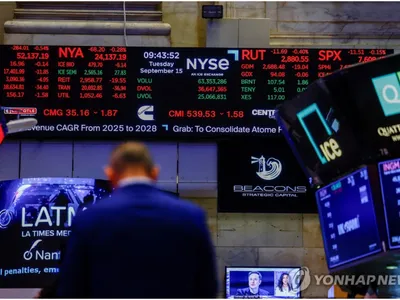
On the 4th, the KOSPI plummeted to the 5,400 level during intraday trading before paring losses to finish up 0.62% at 5,683.80. The KOSDAQ also breached the 700 threshold intraday before recovering to close 1.50% higher at 714.95. While both indices overcame sharp early declines to end in positive territory, they exhibited extreme intraday volatility.
In the elections, the Democratic Party secured majorities in both the House and the Senate. High living costs and discontent with the Trump administration's economic policies are viewed as key catalysts for the Democrats' gains. President Donald Trump has stated that he accepts the election results and intends to cooperate with the Democrats.
While congressional checks and balances will be reinforced, presidential authority over tariffs and foreign policy remains intact. The Democrats' control of Congress could complicate negotiations over the federal budget and fiscal policy, while the prospect of heightened regulations on the artificial intelligence (AI) industry has emerged as an additional burden for U.S. tech sector sentiment.
Mid-to-Late November Rebound Anticipated… Foreign Inflows Will Take at Least Three Months
Hyundai Motor Securities highlighted the possibility of foreign capital returning to the domestic stock market starting in mid-to-late November, once key events such as the U.S. midterms conclude. While Democratic control of Congress could prove favorable for the solar and energy storage system (ESS) sectors, the firm noted that the impact on semiconductors would be limited.
Conversely, Hana Securities diagnosed that a recovery in foreign supply and demand will require a more protracted period. In a report released on the 4th, analyst Lee Kyung-soo analyzed past instances where massive foreign net selling coincided with sharp stock price drops, concluding that a full-fledged recovery could take at least three months.
During similar historical phases, the median KOSPI return stood at 0.1% after one month and -2.0% after three months, before rising to 16.3% at six months and 39.3% at twelve months. Hana Securities' analysis showed that foreign investors shifted to net buyers after six months in only 57% of cases, indicating that stock price recoveries are frequently unaccompanied by foreign buying.
The U.S. credit market is also weighing on foreign capital flows. According to Hana Securities, the U.S. high-yield corporate bond spread recently widened from 2.64% to 3.12%. The correlation coefficient between the intensity of foreign net purchases and high-yield spreads stands at -0.46, illustrating an inverse relationship where heightened U.S. credit risk dampens domestic equity purchases.
Post-Election Six-Month Average Rise of 10.8%… But This Year's Starting Point Differs
When evaluated strictly on the shock of foreign selling, market recovery demands time; yet historical equity trajectories following U.S. midterms have painted a different picture. According to Shinhan Securities, the KOSPI has historically climbed an average of 4.7% three months and 10.8% six months after midterm elections. Across six elections spanning from 2002 to 2022, foreign investors net-purchased the KOSPI during the 20 trading sessions following the vote in five of those instances.
This year, however, the intensity of foreign selling is far more severe. Between October 1 and November 2, foreign investors offloaded a net 19.14 trillion won ($13.8 billion) in the KOSPI. Accounting for 0.4% of total market capitalization, this surpasses the previous peak of 0.31% recorded immediately prior to the 2006 midterms.
Historically, post-midterm periods were often characterized by concurrent stock market rallies and foreign net buying. Conversely, periods marked by massive foreign liquidation saw median KOSPI returns remain in negative territory even three months out—explaining why historical post-election average gains cannot be directly applied to this year's market.
Shinhan Securities analyzed that historical post-midterm stock gains did not vary significantly depending on the partisan composition of Congress. Analyst Kang Jin-hyuk explained that broader macroeconomic conditions and corporate earnings exerted a far greater influence on subsequent market direction than election outcomes.
Although the midterms have reshaped the power dynamics of the U.S. Congress, the Trump administration's authority over tariffs and export controls remains intact. While the domestic stock market successfully recouped intraday losses to close higher, the burden of foreign selling persists. Moving forward, market direction will likely be dictated by foreign supply-demand dynamics, corporate operating profit outlooks, and conditions in the U.S. credit market.