
KOSPI drops 5.28% and Taiwan falls 3.20% on the 5th; both markets plunge roughly 9% intraday on the 6th.
Authorities temporarily exempt mandatory collateral ratios; clear criteria and enforcement plans for additional countermeasures must be formalized.
Financial authorities in Taiwan have raised the possibility of implementing short-selling restrictions in response to the sharp stock market downturn. Meanwhile, South Korea, which suffered a steeper drop than Taiwan a day prior, experienced an even more severe shock today. The KOSPI plummeted over 8% in early trading, triggering a Level 1 circuit breaker at approximately 9:03 a.m. and halting trading for 20 minutes. The sell-off persisted following the resumption, prompting a sell-side sidecar at around 9:34 a.m. The KOSDAQ also activated a sell-side sidecar at approximately 9:06 a.m. Taiwan's market similarly plummeted by about 9% at the open.
According to Taiwan's economic daily Commercial Times and other media outlets, Wellington Koo, Chairperson of Taiwan's Financial Supervisory Commission (FSC), announced that additional market stabilization measures would be unveiled on the afternoon of the 6th. Temporary short-selling restrictions were mentioned as a viable tool, though the definitive adoption and timing of such regulations remain unconfirmed.
Reports indicate that Taiwan's financial authorities stated the previous day that short-selling curbs could be reviewed if irrational panic causes the domestic stock market to experience excessive declines compared to other major economies. While risk indicators—such as margin maintenance ratios—remain at manageable levels, authorities have kept their intervention options open.
South Korea Suffered Steeper Losses Yesterday… Sell-Off Triggers Trading Halts
As of the closing bell on the 5th, the KOSPI finished down 5.28% at 5,383.80. Taiwan's Taiex closed 3.20% lower at 41,574.72. The KOSDAQ also dropped 5.11%, marking a heavier decline for the South Korean market overall.
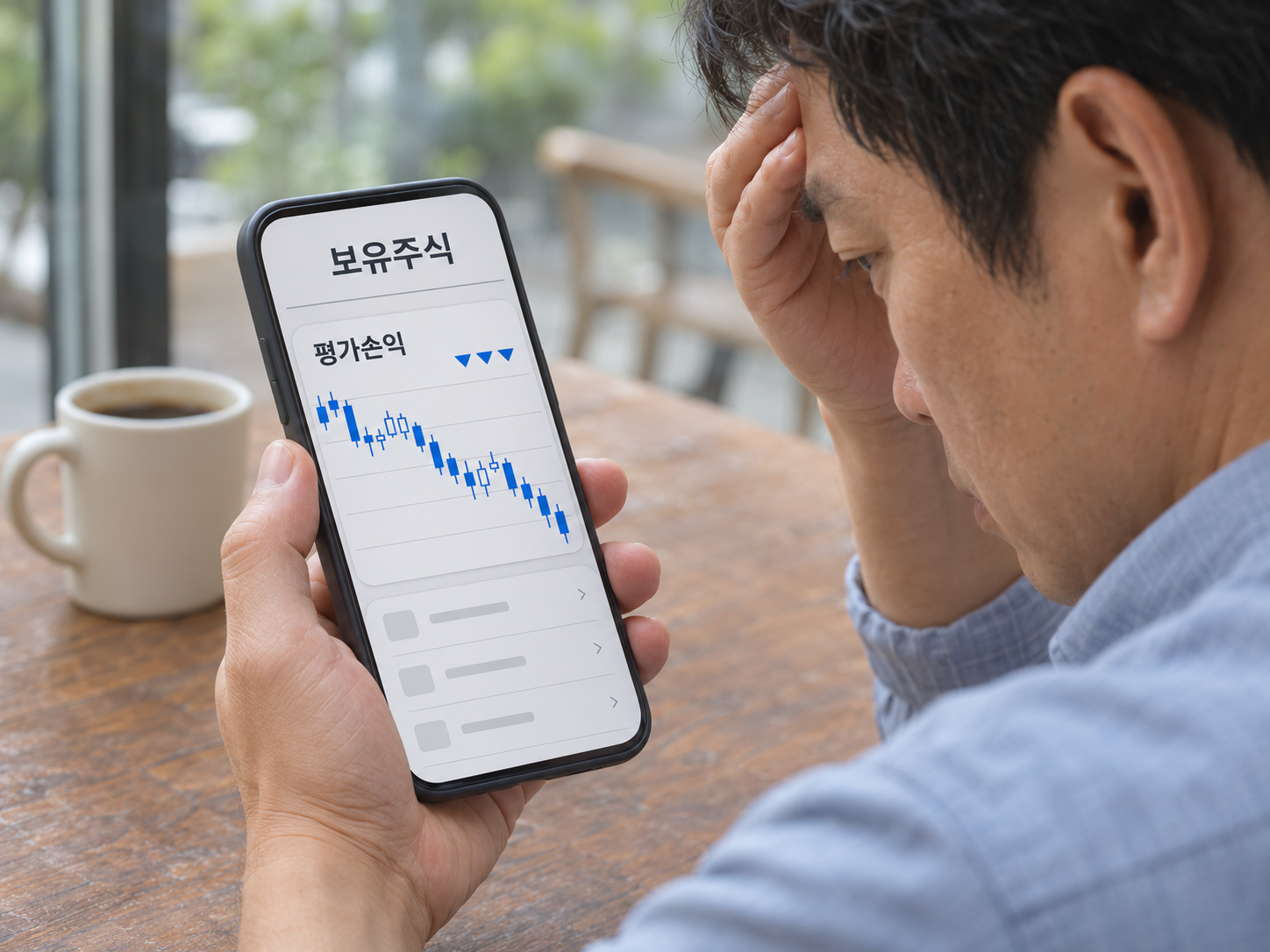
[Photo Description: An AI-generated image illustrating a retail investor's anxiety amid falling stock prices.]
The shock deepened on the 6th. At approximately 9:03 a.m., the KOSPI triggered a Level 1 circuit breaker, plunging 459.19 points (8.52%) from the previous session to 4,924.61. The KOSDAQ also tumbled 6.88% in early trading. During the regular session on the Korea Exchange, the KOSPI ultimately closed down 324.11 points (6.02%) at 5,059.69, while the KOSDAQ fell 34.14 points (5.03%) to finish at 644.27. Taiwan's market likewise plunged nearly 9% early in the session. While the maximum intraday drop alone does not definitively prove that South Korea suffered a worse decline, the sobering reality is that the Korean market—having endured a sharper correction the previous day—was once again shaken to the point of a trading suspension. The subsequent narrowing of losses in both markets does not afford room for complacency.
Diagnosis of "Overreaction" Must Be Met with Clear Intervention Criteria
During an emergency market monitoring meeting held earlier today, domestic economic and financial authorities diagnosed that the local stock market has been excessively reacting to external variables. Consequently, authorities decided to temporarily exempt securities firms from the mandatory 140% margin maintenance ratio on credit financing for three months starting on the 9th, while preparing additional measures should volatility escalate further.
This step is meaningful in that it aims to alleviate forced liquidation pressures. However, to prevent any misunderstandings regarding a blanket halt to forced liquidations, authorities must clearly communicate the eligible targets and operational guidelines for each brokerage.
Furthermore, additional stabilization measures should not remain mere possibilities. Regulators need to promptly inspect whether abnormal signs emerged in short selling, program trading, or cash-futures-ETF linked transactions, and explicitly outline under what conditions specific tools will be deployed.
Reviewing short-selling restrictions does not equate to pinning the market crash solely on short selling. Current loss figures and trading volumes alone cannot substantiate the culpability of any specific trading mechanism. Nor do reports of Taiwan's potential restrictions imply that regulations have been implemented or proven effective.
Nevertheless, causal analysis and preparedness must go hand in hand. Investors can only feel reassured when authorities are fully prepared to immediately execute targeted interventions—such as short-selling regulations, liquidity injections, and relief for margin trading burdens—after thoroughly weighing the necessity and side effects of each tool.
Market stabilization policies are not about defending a specific index, but rather about preventing orderly corrections from degenerating into disorderly panic selling. If financial authorities acknowledge that the market is overreacting, they must demonstrate proactive measures commensurate with that diagnosis. They must avoid repeating the cycle of reacting too late, only locking the barn door after the horse has bolted and market trust has already eroded.