Goldman Sachs reports tech selling speed at highest since 2016, though heavy investment concentration persists
Despite deleveraging, fears of further sell-offs linger; biotech shares hold firm amid surging US Treasuries
Wall Street hedge funds have dumped technology stocks at the fastest pace in nearly a decade. Yet, tech shares still account for 23.5% of the hedge fund portfolios serviced by Goldman Sachs—a high concentration placing it in the top 10% over the past five years.
Although capital that once flooded into artificial intelligence (AI) related stocks has begun to recede, substantial positions remain in the market. The sharp sell-off in US equities on the 5th (local time) underscored how much damage simultaneous liquidations by investors can inflict, compounded by ongoing debates over the growth potential of AI enterprises.
Despite Record Selling in a Decade, Tech Still Makes Up a Quarter of Portfolios
According to Goldman Sachs prime brokerage data, hedge funds net-sold technology stocks over five trading sessions in mid-October at the fastest clip since 2016. The selling pressure was particularly pronounced in the semiconductor sector.
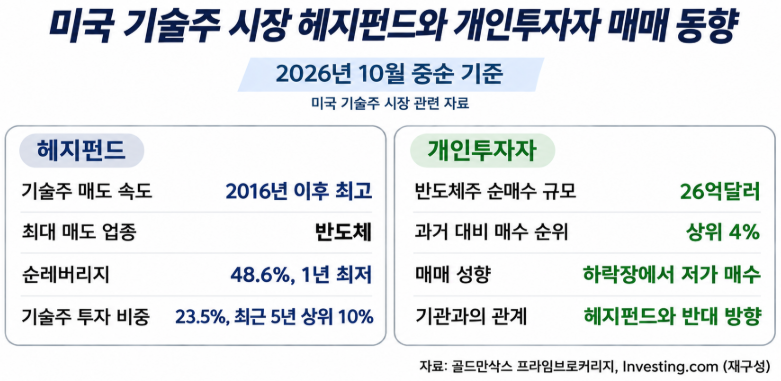 The intensity of net stock sales by hedge funds exceeded historical norms by more than two standard deviations. Net leverage fell to 48.6%, a one-year low, reflecting risk-management efforts through reduced borrowing.
Nevertheless, tech stock allocations stayed at 23.5%, maintaining the upper 10% range of the past five years. This indicates that a significant amount of capital remains tied up in technology even after the massive sell-off.
Institutional and retail trading directions also diverged. During the same week that hedge funds aggressively trimmed semiconductor stocks, retail investors net-bought approximately $2.6 billion—placing it in the top 4% compared with historical buying volumes.
Market analyst Michael Lebowitz noted in an Investing.com column on the 27th of last month that a record pace of selling does not necessarily equate to panic selling. Rather, while high tech allocations have moderated, there remains ample room for additional reductions in holdings.
Conversely, should the market stabilize, hedge funds that have lowered their leverage could ramp up tech purchases once again. However, retail investors who engaged in bottom-fishing in mid-October reversed course and turned sellers during the market rout on November 5th. According to Vanda Research, retail sales of individual stocks at the time were trending toward levels not seen since the COVID-19 pandemic.
Simultaneous Liquidations More Feared Than AI Headwinds; ETFs Face Estimated $47B in Outflows
When capital is heavily concentrated in AI-related shares, declines in a few mega-cap stocks can easily cascade into a broader sell-off. Funds utilizing leverage or strict stop-loss limits may be forced to shed holdings as prices drop. This creates a vicious cycle where selling triggers price declines, which in turn beget further selling.
Asset adjustments by leveraged exchange-traded funds (ETFs) were also cited as a source of selling pressure during the US market slump on the 5th. Nomura estimated that leveraged ETFs would need to offload roughly $47 billion worth of equities near the close of trading—though this figure represents an estimate rather than executed trades.
Leveraged ETFs rebalance their holdings to track a fixed multiple of a benchmark index's daily return. When such transactions concentrate all at once during a steep downturn, they can amplify the losses of major tech and semiconductor stocks.
On the 5th, the Nasdaq 100 index plummeted 6.36% to close at 26,629.81. Roughly $2.5 trillion in market capitalization was wiped out, while the Volatility Index (VIX) spiked as high as 28.36 intraday before settling at 28.18.
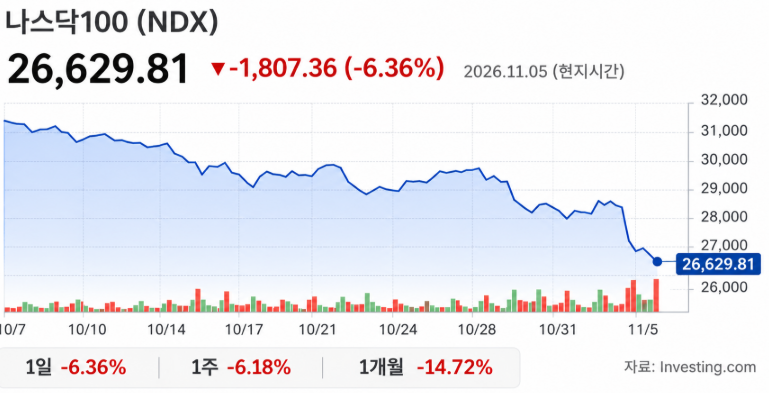 While questions surrounding the profitability of AI investments and uncertainties in the data center business were cited as catalysts, the market is also closely eyeing how accumulated investment concentration and risk-reduction trades exacerbated the downturn.
Short-Term US Treasuries Rally; Biotech Shares Hold Ground Despite KOSPI Slump
As the sell-off rippled primarily through AI and tech stocks, the US Treasury market told a vastly different story. On the 5th (local time), the yield on the 2-year US Treasury note fell 446 basis points (down 12 bps from the previous session) to 4.46%, while the 10-year yield dropped 6 bps to 4.84%. The yield spread between the 2-year and 10-year notes widened to 0.38 percentage points.
Amid an overall decline in bond yields, short-term yields fell