

Global solar power facilities have grown 3.3 times in 5 years... Expected to expand to 3,605GW by 2031
More than 90% of China's major manufacturing companies suffer losses... Opportunity to reorganize Korea’s 87GW distribution and supply chain
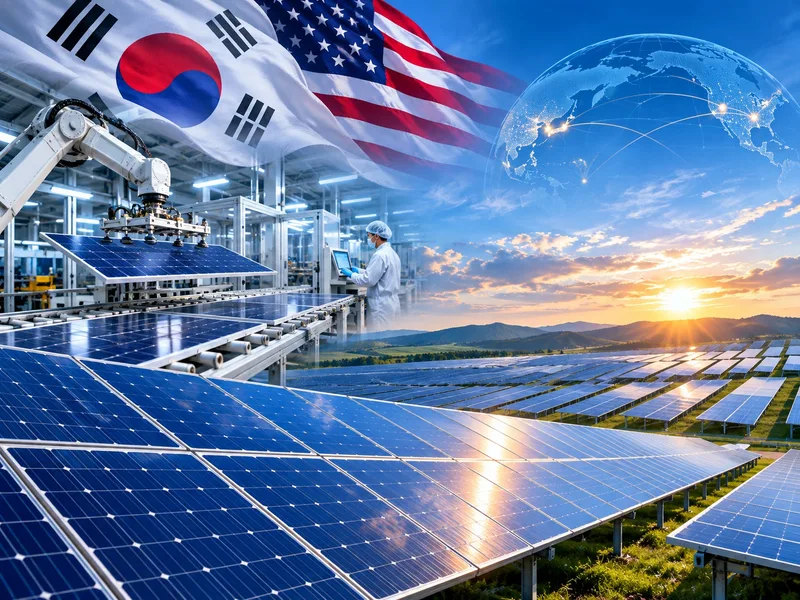
Despite the high growth of the global solar power market, the shadow of recession is looming over the related manufacturing industry. As oversupply from China coincides with the U.S. policy to foster domestic manufacturing, movements to reorganize the global supply chain centered on China are in full swing.
Global solar power generation facilities increased 3.3 times in 5 years from 715GW (gigawatt) in 2020 to 2,383GW in 2025. Last year, solar power accounted for about 74% of the increase in global renewable energy power generation facilities.
However, in China, which accounted for about 97% of global solar wafer production and 79% of module production last year, more than 90% of major manufacturing companies are recording losses this year.
The United States is strengthening the protection of the solar energy manufacturing industry and building a local supply chain, and Korea is also pursuing the supply of 87GW of solar power and the reconstruction of the domestic manufacturing industry by 2030. Amid the reorganization of the global supply chain and expansion of the domestic market, growth opportunities for Korean companies are attracting attention.
Global solar power to expand to 3,605GW by 2031... Hydroelectric power generation to surpass by 2029
According to the International Renewable Energy Agency (IRENA), the share of solar power in the world's renewable energy power generation facilities increased from 25.4% in 2020 to 46.3% in 2025, and from 2023, it will surpass hydroelectric power generation and become the world's largest renewable energy source based on facilities.
In 'Renewables 2026' announced on the 6th, the International Energy Agency (IEA) predicted that global solar power generation facilities will increase by 3,605GW between 2026 and 2031. This accounts for approximately 75% of the total increase in renewable energy facilities.
Solar power for large-scale power generation projects is expected to increase by 2,075GW, and distributed solar power for residential, commercial, and industrial facilities is expected to increase by 1,530GW.
From 2029, solar power is expected to surpass hydroelectric power in terms of actual power generation. Global solar power generation is expected to increase 2.3 times from approximately 2,700 TWh (terawatt hours) in 2025 to approximately 6,300 TWh in 2031, and its share of global electricity production is expected to double from 8% to 16% over the same period.
The center of market growth is also changing. From January to September of this year, new solar power facilities in China decreased by about 55% compared to the same period last year due to the switch to a competitive bidding support system.
On the other hand, the IEA raised its forecast for expansion of U.S. solar power facilities from 2026 to 2030 by 45% compared to the previous year's report, reflecting the increase in power demand from AI data centers and the expansion of large-scale power generation projects. India and Southeast Asia are also emerging as major growth markets.
Oversupply in China, reorganization of U.S. supply chain... Changes in manufacturing competitive structure
According to IEA PVPS, the annual production capacity of global solar modules in 2025 reached 1,531GW, but actual production was 722GW, less than half of the production capacity. Manufacturers' profitability has worsened as oversupply continues in major materials and components such as polysilicon, wafers, and solar cells (cells).
Although solar module prices have rebounded somewhat this year, the global average wholesale price is about $0.12 per watt (W), which is still less than half of what it was before 2023.
More than 90% of China's major solar energy manufacturing companies analyzed by IEA are recording losses. The combined net loss of major vertically integrated manufacturing companies and polysilicon producers expanded from $4.4 billion in 2024 to $5.5 billion in 2025, and the number of companies that have applied for bankruptcy or liquidation since 2024 has exceeded 70.
On the other hand, the median net profit margin of major non-Chinese manufacturing companies has generally remained at 10-15% since 2023. Policy protection such as technological differentiation, local production base, and import regulations supported profitability.
The United States plans to implement a minimum import price system for polysilicon, ingots, wafers, cells, and modules and additional tariffs on some products starting December 4. The minimum import price of solar modules is $0.38 per watt, which is more than three times the current global average wholesale price.
Expanding power generation demand and manufacturing protection policies are expected to be an opportunity for Korean companies that have secured local production in the U.S. and non-Chinese supply chains. However, the cost burden due to rising prices of imported raw materials and parts must also be considered.
Korea, 87GW of solar power in 2030... Rebuilding the manufacturing industry is key
The Ministry of Climate, Energy and Environment presented the goal of expanding solar power generation facilities from 30.8GW in 2025 to 87GW in 2030 in the '1st Renewable Energy Basic Plan' last May. With the addition of 56.2GW over 5 years, approximately 90% of the increase in domestic renewable energy facilities corresponds to solar power.
The government plans to expand distribution sites such as factory roofs, agricultural and floating solar power, and increase domestic solar module production capacity to more than 10GW per year by 2030.
However, the domestic solar energy manufacturing industry has been experiencing the double whammy of a sharp decline in exports and an increase in imports.
Domestic solar module exports decreased by 96.7% in three years from $1,547.7 million in 2022 to $51.02 million in 2025. On the other hand, imports increased by 39.7% from $269.9 million to $377.02 million over the same period.
However, the decline in module exports was influenced not only by price competition from China but also by Korean companies' expansion of local production in the United States.
In order to rebuild the domestic solar energy manufacturing industry, it is necessary to secure a stable demand base for domestic modules and strengthen technological and price competitiveness centered on high-efficiency products.
From solar power supply chain to power generation business... Growth opportunities for Korean companies
Hanwha Solutions (009830) is focusing on expanding local production in the U.S. and securing next-generation solar cell technology.
We have secured an annual module production base of more than 8GW in Dalton and Cartersville, Georgia, and are building an ingot, wafer, cell, and module production system through Cartersville's 'Solar Hub'.
In the third quarter of this year, the new and renewable energy sector recorded sales of 2.1632 trillion won and operating profit of 105.1 billion won. Module and other sales amounted to KRW 718.2 billion, an increase of 66% compared to the same period last year.
We plan to invest approximately KRW 900 billion in building a next-generation perovskite tandem solar cell mass production line and converting to a high-efficiency, high-output production line.
OCI Holdings (010060) is expanding its business area to wafers based on the non-Chinese polysilicon supply chain.
Through its Malaysian subsidiary OCI Terrasus, it has an annual production capacity of 35,000 tons of solar polysilicon. It has signed a long-term supply contract with a new customer in the United States, and plans to expand its production capacity to 70,000 tons by 2029.
OCI Terrasus recorded sales of 162.2 billion won and operating profit of 20.8 billion won in the third quarter of this year. Polysilicon sales increased 45% compared to the previous quarter, achieving a surplus for the first quarter of this year.
Neo Silicon Technologies, a Vietnamese wafer production corporation, plans to pursue full-scale supply from the first quarter of 2027 and expand production capacity from 2.7GW this year to 11.5GW in 2029.
HD Hyundai Energy Solution (322000) is expanding its domestic and overseas markets based on its competitiveness in manufacturing high-efficiency cells and modules.
The Eumseong factory in North Chungcheong Province has an annual solar cell production capacity of 400MW (megawatts) and 1.2GW of modules. In the third quarter of this year, solar module sales increased by 30.9% to KRW 120 billion compared to the same period last year, and solution sales including inverters and power generation systems also increased by 5.9% to KRW 30.3 billion.
Last March, a solar module supply contract worth 127.8 billion won was signed with Hillsboro Solar of the United States. In response to increased domestic and international demand, expansion of cell production facilities and construction of a new factory are also being considered.
The goal of supplying 87GW of domestic solar power is expected to be a new growth opportunity not only for module manufacturing but also for power plant construction and operation companies.
Shinsung ENG (011930) is conducting solar module manufacturing and building-integrated photovoltaic (BIPV) business based on its Gimje factory in Jeollabuk-do, while S-Energy (095910) is engaged in module manufacturing and power plant construction and operation management business.
SDN (099220) recorded cumulative solar power sales of KRW 48 billion (68.4% of total sales) in the third quarter of this year, focusing on building power generation systems and supplying equipment. SK Eternix (475150) is expanding its power generation asset operation and direct power purchase agreement (PPA) business, including completing the purchase of a cumulative 220MW of solar power generation assets.
The growth of the global solar energy market is a new opportunity for Korean companies. The key is how much added value can be secured based on local production in the United States, non-Chinese supply chain, high-efficiency technology, and power generation business capabilities.
In the next episode, the Market Times highlights the growth prospects of the onshore and offshore wind power market and the global competitiveness of Korean wind power companies.