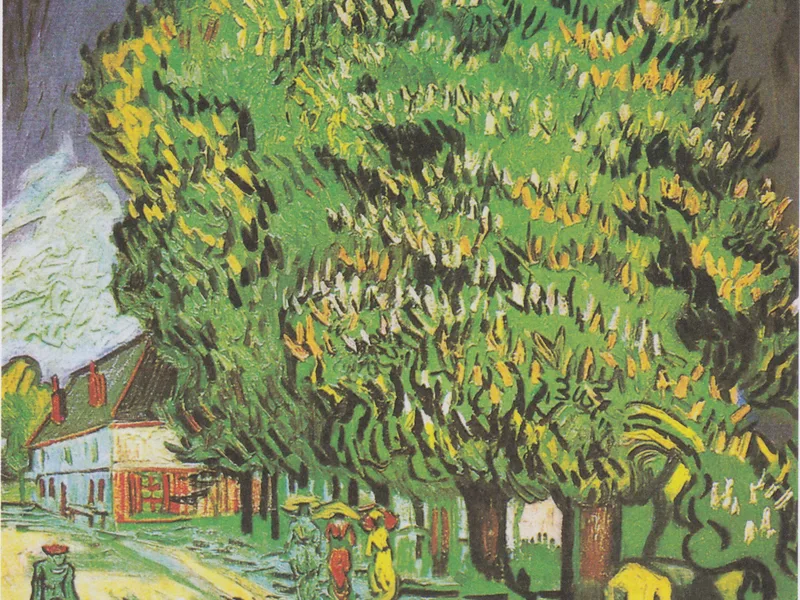
Former owner's family "Sold due to Nazi persecution"... Sotheby's "We cannot confirm coercion" Ownership history is only a transaction channel... It must also be verified whether there was freedom not to sell.
According to a report by the New York Times (NYT) on the 13th (local time), the bereaved family of the former owner of Vincent van Gogh's 1890 painting 'Châtaigniers en fleurs', which is scheduled to be auctioned at Sotheby's in New York, demanded a halt to the sale. The bereaved family claims that the deal made in 1936 was a forced sale due to Nazi persecution. The scheduled auction date is the 18th local time.
Sotheby's has conducted an extensive investigation into the ownership history of the work, but has not yet confirmed that it was sold under coercion. He also added that he is discussing with the bereaved family to find a mutually satisfactory solution.
Whether the sale was forced or not is still a subject of dispute. We are not at the stage to conclude that this work is Nazi loot or to say that the current owner's rights have been denied. However, questions cannot be postponed just because a conclusion has not been reached. Since a specific objection has been raised, the auction market must explain what data it used to verify the details of the transaction.
매매 기록이 설명하지 못하는 것
According to the collection history released by Sotheby's, German publisher Samuel Fischer purchased this painting in 1909. The work was entrusted to the Paul Cassirer Gallery in Amsterdam in 1932 or 1933, and passed on to Fischer's family after his death in 1934. Afterwards, in 1936, it was passed on to Henriette and Marcel Capperet of Paris.
This record shows from whom the painting was moved. But it doesn't explain why the family sold it or whether they had a choice not to sell it.
The bereaved family claims that their publishing business took a hit under the Nazi regime, and that they suffered restrictions on taking out their assets and the burden of the so-called "reich flight tax" while leaving Germany. According to the family's lawyer, Gunnar Schnabel, the painting was sold about three months after the family left Berlin and moved to Vienna.
At the time, the Netherlands was not under Nazi rule. However, the bereaved family argues that the mere fact that the transaction took place outside of Germany does not mean that the sale was unrelated to Nazi persecution. Attorney Schnabel stated that it is necessary to consider not only whether it was sold at market price, but also whether the family would have wanted to sell it even if the Nazi regime had not existed.
This is also the point that needs to be checked in this dispute. Where the work was traded and what pressure the owner was under are two different questions. Just because the place of transaction was outside the border does not mean that the owner was immune from the effects of persecution.
Of course, we should not judge every sale as a coercive transaction simply because it was owned by a persecuted family. Proof of individual transactions is required. However, the search for evidence should not end with checking ownership transfer records. The substance of the transaction can only be accessed by reviewing the circumstances of the sale, the possibility of receiving and using the money, and the family's economic situation at the time.
What you need to check is not only whether the owner on paper has changed, but also under what conditions that choice was made.
경매회사는 가격만 중개하는 곳이 아니다

[Photo caption=Sotheby's headquarters Breuer Building in Manhattan, New York, USA. Taken on August 24, 2026. Source = Ajay Suresh / Wikimedia Commons, CC BY 4.0 ]
When it comes to trading high-priced art, auction houses provide not only sales opportunities. It provides research on the work and its collection history, as well as trust in the research. Buyers buy a painting, but they must also decide whether they can own the painting with confidence.
The New York Times reported that when an open dispute like this one arises, potential buyers may hesitate. Art advisor Philip Hoffman said the situation was burdensome for Sotheby's, the owner, and the buyer.
Questions about historical legitimacy are not secondary issues to be considered after the transaction is completed. It is a problem within the market that can affect the establishment of transactions and prices. The assurance that it is genuine does not resolve questions about its ownership history.
Sotheby's also provided evidence. According to a report by Art News, an art media outlet, Sotheby's explained that this painting was sold for 68,000 Swiss francs in June 1936, based on the records of the Paul Cassirer Gallery, which was a good price for a Van Gogh work at the time.
So the next question the market must ask is clear. Did you sufficiently review not only the sale price but also the circumstances that led to the family selling the painting? What are the gaps in the remaining records?
This is different from the claim that Sotheby’s must legally prove ‘the fact that there was no coercion’. As a business that brokers high-value transactions and provides trust, this is a request to fully explain the basis and limitations of judgment.
The explanation that ‘no coercion was confirmed’ and the explanation that ‘it was confirmed that it was a free transaction’ are not the same. If the auction market blurs this difference, the uncertainty is not resolved but passed on to the buyer.
It is necessary to distinguish between whether it can be sold legally and whether the market can trust and trade it. The fact that the dispute has not yet been resolved does not eliminate the auction company's responsibility to provide explanations.
합의가 이뤄져도 설명은 남아야 한다
According to the New York Times, Sotheby's and the family's legal representatives were scheduled to discuss a potential settlement in New York on the 16th local time. The bereaved family also conveyed their intention to seek a fair and just solution in accordance with the spirit of the 1998 Washington Principles.
Agreement can be a realistic solution to adjust the rights and interests of the parties. However, resolving disputes so that an auction can proceed is one thing, and explaining the circumstances of past transactions is another. Even if an agreement is reached, it must be differentiated between what facts have been confirmed and what is uncertain.
The rights of the current owner must be respected, and the claims of the bereaved family must be verified with evidence. However, the mayor's responsibility does not end with simply introducing both sides' positions side by side. What needs to be confirmed is not only the fact that the painting's owner changed, but also what pressure the owner was under at the time to dispose of the work.
This debate is not about nullifying all past transactions. If the connection between persecution and sale has been specifically raised, the legitimacy of the transaction cannot be explained solely through sale records. Ownership history shows who the painting has passed through. It must be separately verified whether the process was justified.