

Two FOMC participants raised the possibility of a hike exceeding 0.25 percentage points in December if inflation worsens. Goldman Sachs projects hikes in December and March, while BofA and Deutsche Bank anticipate three consecutive increases.
Although the U.S. Federal Reserve held interest rates steady in October, nearly all meeting participants agreed that further rate hikes would be necessary if inflation and employment data evolve as expected. While Goldman Sachs, Bank of America (BofA), and Deutsche Bank all anticipate a 0.25 percentage point hike in December, their outlooks for January diverge. Goldman Sachs expects inflation to moderate by year-end, leading to a pause in January. Conversely, BofA and Deutsche Bank argue that the Fed's response to inflation is already behind the curve, necessitating continued hikes into the new year.
Pause Intended to Assess September Hikes; Concerns Over Inflation Diffusion
According to the minutes from the October 27-28 Federal Open Market Committee (FOMC) meeting released on the 18th, the committee maintained the benchmark interest rate at 3.75-4.00% with a 10-2 vote. Fed Governor Lisa Cook and Cleveland Fed President Beth Hammack dissented, advocating for a 0.25 percentage point increase. Even among those who supported the pause, several noted the difficulty of the decision between hiking and holding.
Those favoring a pause emphasized the need to observe the lagged effects of the September rate hike. They noted that mortgage rates have already risen and corporate bond issuance for lower-rated firms has declined. Some participants also expressed a need to verify the sustainability of AI-related investment demand. The fact that market expectations for December and future hikes aligned with their own assessments helped mitigate the risks associated with the October pause.
However, the case for further tightening remained compelling. Household consumption and business capital expenditure remain robust, and most participants observed that inflationary pressures are broad-based. Many pointed out that supply constraints in AI infrastructure are driving up prices even in consumer electronics, suggesting that inflation is spreading beyond sectors directly tied to data center construction. Two participants suggested that if future inflation data proves unfavorable, a hike exceeding 0.25 percentage points could be considered in December.
Core Inflation Rises 0.3% for Third Consecutive Month; Divergence Between Waller and Williams
The October Consumer Price Index (CPI), released on November 10, rose 0.4% from the previous month, a deceleration from September's 0.6%. However, core CPI—excluding food and energy—has risen 0.3% for three consecutive months.
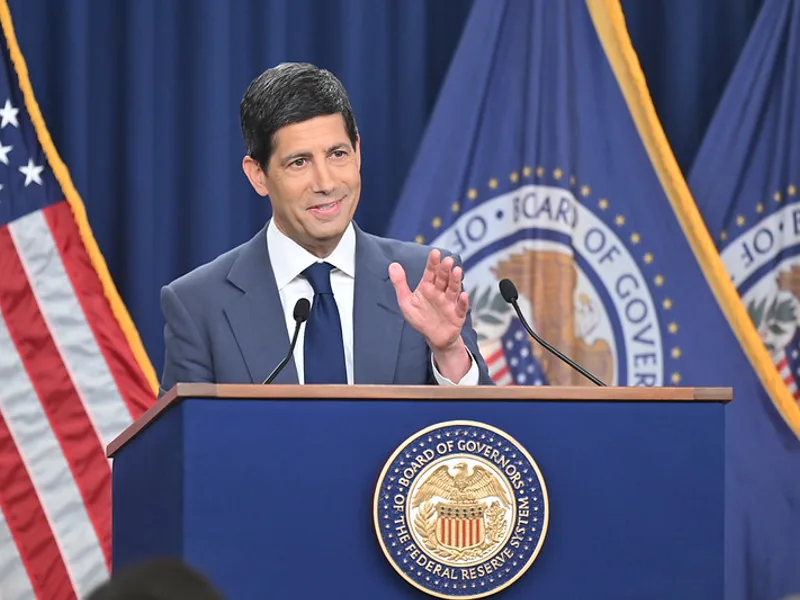
Fed Governor Christopher Waller stated in a CNBC interview on the 18th that if the Fed does not clearly signal a January hike to the market, it should consider a 0.5 percentage point hike in December. He argued that stronger action is required as inflationary pressures permeate the service sector and beyond. This approach contrasts with the cautious communication style historically associated with Fed Chair Kevin Warsh.
New York Fed President John Williams stated on the 17th that if consumption and investment remain strong, further rate hikes may be warranted, though he did not explicitly call for a large-scale increase at this juncture.
Goldman Sachs Focuses on Year-End Cooling; BofA Highlights Delayed Response
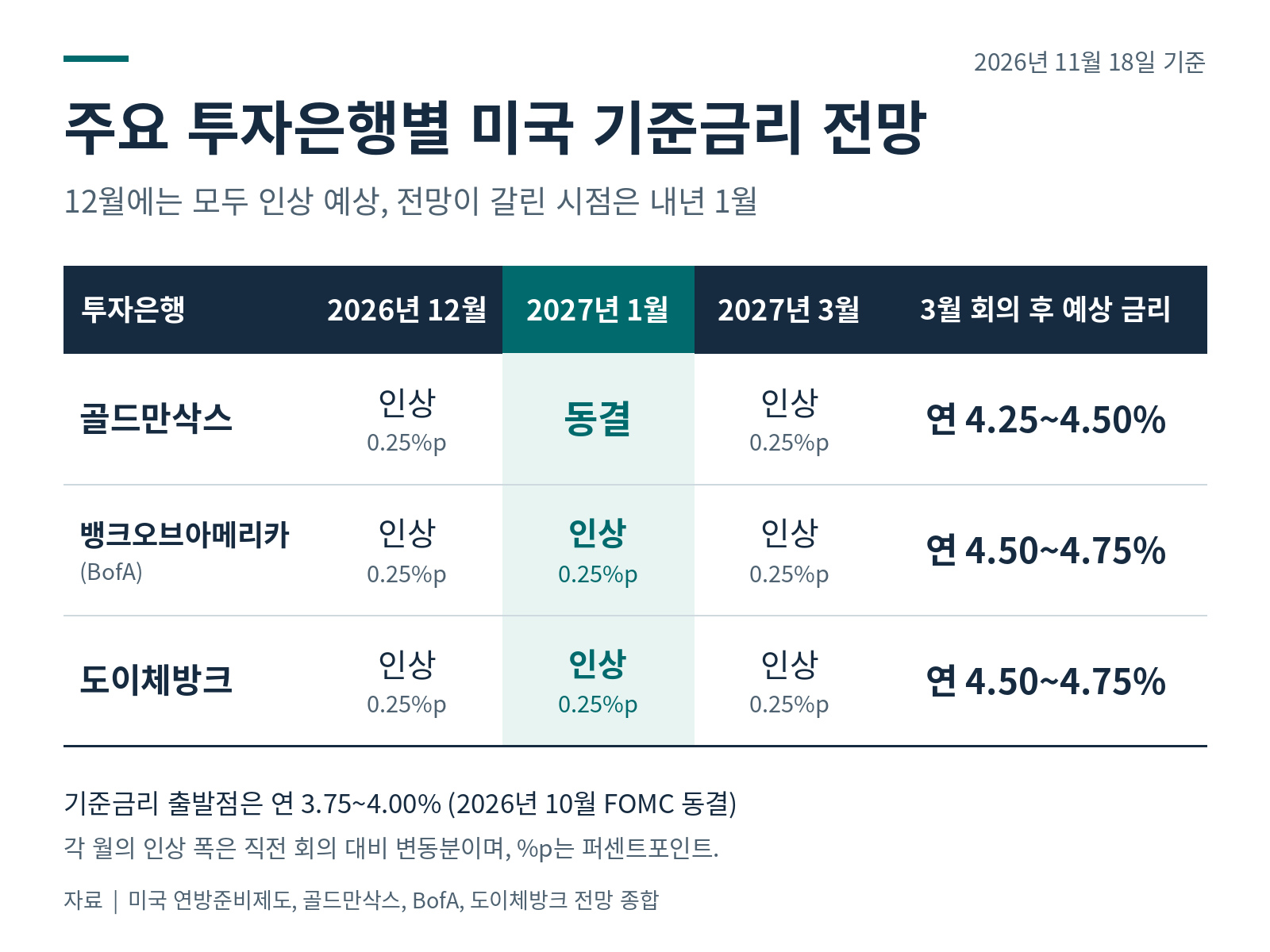
Investment banks adjusted their forecasts following the October CPI release. David Mericle, Chief U.S. Economist at Goldman Sachs, noted in a report on the 10th that while inflation may cool by year-end, price pressures are likely to resurface early next year. Consequently, he projects a 0.25 percentage point hike in December, a pause in January, and another hike in March, bringing the terminal rate to 4.25-4.50%.
BofA updated its outlook on the 13th, adding a January hike to its previous forecast. They argue that the higher-than-expected October CPI indicates the Fed is behind the curve and that quarterly hikes are insufficient to curb inflation. Deutsche Bank similarly added a January hike, projecting 0.25 percentage point increases in December, January, and March. They believe the Fed is more likely to split a 0.5 percentage point move into two 0.25 percentage point increments to accommodate members who prefer a gradual approach. Under the BofA and Deutsche Bank scenarios, the terminal rate would reach 4.50-4.75% by March.
Following the release of the minutes, the futures market also priced in a higher probability of hikes in both December and January. According to Bloomberg, as of the 18th, U.S. interest rate futures reflected expectations for 0.25 percentage point hikes in December and January, with an additional hike anticipated by April.
Key indicators to watch before the Fed's December 9 decision include the October Personal Consumption Expenditures (PCE) price index on November 25 and the November employment report on December 4. The November CPI will be released on December 10, the day after the rate decision. If the Fed hikes by 0.25 percentage points in December, the primary focus will be on how clearly the policy statement and Chair Warsh’s press conference signal the potential for further action in January.