HYBE’s paid fan services, SM’s joint venture with Tencent, and CJ ENM’s local group debuts signal a diversification of revenue models in China.
Despite a surge in entertainment stocks, the resumption of large-scale concerts remains uncertain, with local revenue contributions to headquarters serving as a key variable.
Even before the doors to the Chinese market have fully reopened, South Korean entertainment companies have begun to overhaul their entry strategies. Unlike the past, when the focus was primarily on supplying Korean-produced content to China, firms are now expanding their business scope by leveraging local platforms to grow fandoms and co-developing artists with Chinese partners. With HYBE, SM Entertainment, and CJ ENM establishing local subsidiaries and joint ventures, growing anticipation for the easing of the 'Hallyu Ban' (restrictions on Korean cultural exports) has brought the practical profitability of Chinese operations back into the spotlight.
Bloomberg reported on the 19th (local time) that major K-pop agencies are seeking to expand their local presence after navigating nearly a decade of regulatory headwinds in China. While expectations for improved bilateral relations and cultural exchange are rising, the resumption of large-scale K-pop concerts in mainland China remains uncertain.
Establishing Local Entities and Nurturing Artists: A Shift in Strategy
Domestic entertainment firms have been laying the groundwork by establishing local subsidiaries and joint ventures well before the current optimism regarding the easing of restrictions.
HYBE established its local subsidiary, 'HYBE China,' in Beijing last April. Unlike its other overseas branches, the focus in China is on supporting existing artists and securing a business foundation rather than directly training new local groups.
SM Entertainment is strengthening its partnership with Tencent Music Entertainment (TME). Following a memorandum of understanding signed last May for joint idol production, the two companies established a joint venture, 'STE,' in Beijing this July. STE aims to debut a new Chinese idol group within the next two to three years and will support the local activities of SM’s Greater China-based artists.
Tencent Music became a major shareholder in SM last May, acquiring a 9.38% stake previously held by HYBE for approximately 243.3 billion KRW. The two companies are expanding their cooperation beyond music distribution to include content production, local marketing, and concert operations.
CJ ENM also launched a joint venture, 'ONECEAD,' in February in partnership with NCC Entertainment—a company co-founded by JYP Entertainment’s Chinese subsidiary and Tencent Music. ONECEAD manages the seven-member group MODYSSEY, which debuted in April, and is expanding into music production, concerts, and merchandise (MD) businesses.
Revenue Streams: Music, Merchandise, and Subscriptions
Even during the prolonged ban, K-pop consumption in China did not cease entirely. While large-scale concerts were restricted, sales of music, albums, merchandise, and fandom services continued through local platforms.
HYBE’s fandom platform, Weverse, opened an official store on Alibaba’s Tmall last June. In November, it formed a strategic partnership with Tencent Music’s QQ Music to introduce 'Weverse DM,' a paid fan communication service. The service is designed to be accessible directly within the QQ Music app, with a launch date set for November 18.
This model allows companies to sell products and subscription services via Chinese platforms without building their own large-scale distribution networks. HYBE CEO Lee Jae-sang highlighted the potential of these partnerships and paid subscription services during last year’s earnings call. Tencent Music also disclosed the renewal of its music content cooperation agreement with HYBE in its third-quarter earnings report this year.
SM is similarly expanding its scope through Tencent Music’s platforms, utilizing their user base and marketing capabilities to sell photo cards, merchandise, and host pop-up stores.
Significant contracts are already being signed in the music distribution sector. Cube Entertainment disclosed in September that its three-year music distribution contract with Tencent Music, running from October 2023 to September 2026, is valued at approximately 12.22 billion KRW.
However, contract values do not equate to operating profit for domestic firms. Revenue is subject to platform distribution fees and settlement conditions, and profit must be distinguished from gross revenue. Furthermore, while joint ventures allow for the sharing of production costs, profits are distributed based on equity stakes and contractual terms.
Market Reaction and the Profitability Outlook
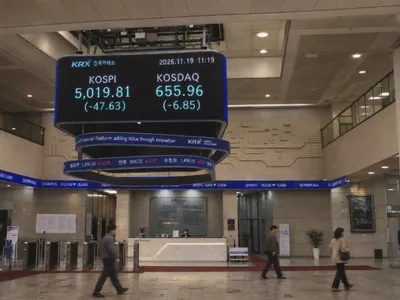
The domestic stock market reacted swiftly to news of progress in the Korea-China Free Trade Agreement (FTA) service and investment negotiations. On November 18, SM Entertainment rose 14.30%, JYP Entertainment 8.72%, HYBE 7.62%, and YG Entertainment 4.92%.
However, the FTA agreement did not include a blanket permit for large-scale concerts by Korean artists. Local performances still require Chinese government approval, and direct distribution of Korean dramas remains subject to separate review processes.
Hana Securities analyzed that if K-pop concerts and variety show production are permitted in mainland China, the entertainment sector’s profit outlook could be upgraded by approximately 30%. Nevertheless, this is a long-term forecast contingent on further deregulation. Daol Investment Securities noted that given the 3-6 month lead time required to secure venues, any meaningful impact on earnings from concert resumptions would likely not materialize until the second half of 2027 at the earliest.
Ultimately, while the scale of Chinese operations may grow, the translation of that growth into net profit for domestic headquarters remains the critical challenge. As each company employs different localization strategies and stages of development, the actual impact of the Chinese market expansion will depend heavily on the performance of these joint ventures and their specific profit-sharing structures.