

One year after the US-Korea trade agreement, Washington pushes for additional tariffs targeting manufacturing overcapacity.
Existing tariff caps expected to hold, but global production networks face mounting pressure.
South Korean industry is once again bracing for tariff announcements from Washington. Just one year after securing a reprieve in trade negotiations by pledging $350 billion in investments in the US, the country is now facing a new trade challenge: US concerns over manufacturing overcapacity, following previous scrutiny regarding forced labor.
Even if existing tariff conditions for South Korean goods remain, there is little room for complacency. The reach of these potential new tariffs extends to the overseas production bases that domestic firms have spent decades building.
Reuters and The Wall Street Journal (WSJ) reported on the 24th (local time) that the Office of the United States Trade Representative (USTR) is expected to soon announce the results of an investigation into industrial overcapacity across 16 economies, including South Korea, China, Japan, and the European Union (EU), along with plans for new tariffs.
While tariff rates are expected to be applied differentially by country, reports suggest that the 15% level established in last year's trade agreement will be maintained for South Korea, Japan, and the EU.
Korean Petrochemical Sector Cuts Capacity Amid Slump, While US Cites It as Evidence of Overproduction
The USTR investigation document released in March detailed the specific grounds for including South Korea. The USTR highlighted that South Korea's global goods balance swung from a $10 billion deficit in 2023 to a $52 billion surplus in 2024, specifically citing key export items such as electronics, automobiles and parts, machinery, steel, and ships.
Of particular note is the petrochemical sector. The USTR explicitly cited the South Korean government's acknowledgment of the need to reduce production capacity in the petrochemical industry as evidence for its investigation.
There is a significant disconnect between this interpretation and the reality of domestic firms, which are shutting down plants and streamlining facilities due to being squeezed by Chinese oversupply. While these moves are structural adjustments for industrial survival in Korea, the US has utilized them as data to determine overcapacity.
In a submission to the USTR in April, the South Korean government emphasized that its domestic industry operates according to market economy principles. During a public hearing in May, officials explained that the government is supporting voluntary business restructuring through measures such as the Special Act on Strengthening the Competitiveness of the Petrochemical Industry.
The industries under investigation also include semiconductors, batteries, robotics, and shipbuilding—sectors that many nations are fostering as future growth engines. South Korea's strategy of nurturing these industries through subsidies and policy financing could become a flashpoint for future trade friction.
With Reciprocal Tariffs Invalidated, US Uses Section 301 to Exert Trade Pressure
Last year, South Korea pledged $150 billion in shipbuilding cooperation and $200 billion in strategic investments, successfully lowering reciprocal tariff rates from 25% to 15%.
However, after the US Supreme Court invalidated the imposition of reciprocal tariffs based on the International Emergency Economic Powers Act (IEEPA) in February, the US sought new mechanisms for tariff imposition. The Trump administration’s invocation of Section 301 of the Trade Act allows for investigations into the industrial policies and trade practices of trading partners to justify tariffs.
Based on this, tariffs related to forced labor were introduced in July, with South Korean products generally subject to a 12.5% rate when combined with existing Most-Favored-Nation (MFN) tariffs.
The Financial Times (FT) has suggested that additional tariffs on South Korea, Japan, and the EU resulting from this overcapacity investigation could be limited to the 2.5% to 5% range. The specific increase for South Korea and the method of combining it with existing tariffs have not yet been disclosed.
The US is also considering future hikes to the tariff rates currently being determined. According to the WSJ, provisions are being discussed that would allow for further increases if overcapacity issues in the target countries worsen or if there is no change in their industrial policies.
Furthermore, separate item-specific tariffs under Section 232 of the Trade Expansion Act remain in effect for automobiles and steel, making it difficult to gauge the total burden on key export industries based solely on the conditions secured in last year's US-Korea trade agreement.
While Korea May Keep 15%, Factories in Vietnam and India Face Uncertainty
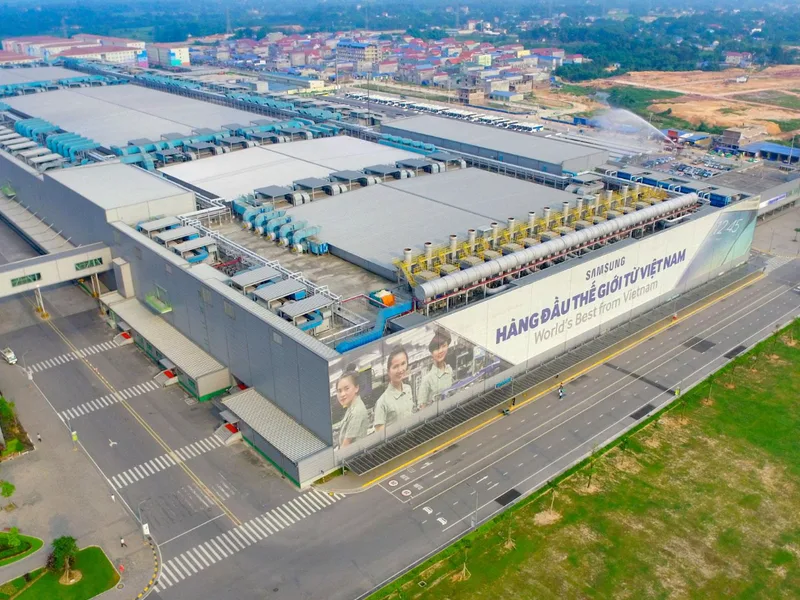
Domestic firms are watching Vietnam and India as closely as they are watching South Korea. These two nations, which serve as major smartphone production hubs for Samsung Electronics, as well as Indonesia, Mexico, and Malaysia, where many Korean manufacturers operate, are also included in the US overcapacity investigation.
Tariffs are applied based on the product's country of origin and category, not the nationality of the company. Samsung Electronics products classified as "Made in Vietnam" are subject to Vietnam's tariff conditions, not the US-Korea trade agreement.
The FT reported that countries with higher existing tariff rates, such as Vietnam, Cambodia, and Malaysia, could face a greater burden of additional tariffs than South Korea or Japan. The actual impact will depend on the product-specific criteria the US eventually releases.
The global supply chain that South Korean manufacturers expanded to reduce reliance on China and cut production costs has now become exposed to trade risks. Yet, it is impossible to simply relocate overseas factories and supplier networks that have been built over many years based on fluctuating tariff rates.
The burden on South Korean firms has intensified, as they must now balance massive capital expenditures for expanding US-based production facilities while simultaneously maintaining the cost competitiveness of their existing Asian production hubs.