80% overall response rate and 12-month complete response maintenance, including high-risk lymphoma patients
Zero cases of CRS or neurotoxicity; 1 billion-cell high-dose trial results to be unveiled in December
HLB Innovation's (024850) next-generation CAR-T therapy has demonstrated a 60% complete response (CR) rate in a clinical trial targeting blood cancers. Some patients maintained a complete response up to 12 months post-treatment, while major immunotoxicities—namely cytokine release syndrome (CRS) and immune effector cell-associated neurotoxicity syndrome (ICANS)—were completely absent. Preclinical studies in solid tumors also confirmed faster tumor control and lower cytokine production levels compared to conventional CAR-T therapies.
According to HLB Innovation, interim phase 1 clinical results for Verismo Therapeutics' blood cancer CAR-T therapy, "SynKIR-310," under the trial name "CELESTIAL-301," were included in the official abstract released on December 4 for the American Society of Hematology (ASH 2026) conference. The study has been selected for an oral presentation at the ASH Annual Meeting, which will take place in New Orleans, USA, on December 13.
Including High-Risk Lymphoma… 12-Month Complete Response Maintained
SynKIR-310 is a CAR-T therapy targeting the CD19 protein on the surface of cancer cells, currently being developed for patients with relapsed or refractory B-cell non-Hodgkin lymphoma who have undergone at least two prior lines of therapy.
As of July 14, six patients had been treated across the first two dose cohorts. Among them, four of the five evaluable patients showed a therapeutic response, resulting in an overall response rate (ORR) of 80%. Three patients achieved a complete response (CR) with no detectable signs of cancer, marking a 60% complete response rate.
The median time to response was one month. One patient who achieved a complete response maintained that response 12 months post-treatment, and the median duration of complete response has not yet been reached.
The median age of the patients was 72 years. All three patients with aggressive lymphoma harbored double-hit or triple-hit genetic features, and all patients presented with stage 3 or 4 disease. The median number of prior therapies was two, indicating the inclusion of challenging, high-risk patient cohorts.
Safety evaluations revealed no major immunotoxicities. None of the six treated patients experienced cytokine release syndrome (CRS) or immune effector cell-associated neurotoxicity syndrome (ICANS), and no treatment-related serious adverse events or dose-limiting toxicities (DLTs) were reported.
Grade 4 neutropenia and leukopenia were each observed in one patient. Three of the total patients received their treatments in an outpatient setting.
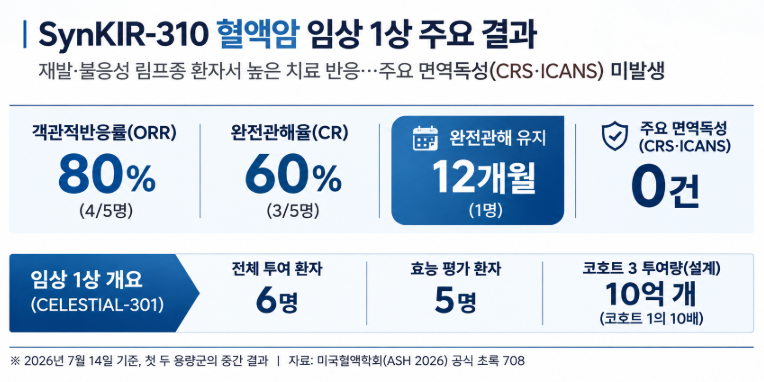 The clinical trial is structured to evaluate safety and optimal dosing by incrementally escalating the number of administered cells. Cohort 1 received 100 million cells, Cohort 2 received 300 million cells, and Cohort 3 is designed with 1 billion cells—ten times the dose of the first cohort.
Verismo plans to disclose additional clinical data from Cohort 3 alongside pharmacokinetic and pharmacodynamic (PK/PD) analysis data during its oral presentation at ASH in December. Key evaluation points will include changes in treatment efficacy and safety profile corresponding to dose escalation.
Direct Comparison with Conventional CAR-T… Expanding Research in Blood and Solid Tumors
At the upcoming ASH conference, Verismo will also present two poster presentations detailing preclinical studies comparing the anti-cancer efficacy and safety of its KIR-CAR technology against conventional CAR-T therapies.
The first study focused on a dual-targeting KIR-CAR technology directed simultaneously against CD19 and CD20. Designed to address the challenge of relapses caused by cancer cells losing or altering target antigens following conventional CD19-targeted CAR-T therapy, this approach showed significantly reduced cytokine production compared to traditional single-chain dual-targeting CAR-T therapies.
The second study directly compared the blood cancer therapy SynKIR-310 with conventional single-chain CD19 CAR-T therapies. In preclinical models of leukemia and lymphoma, SynKIR-310 demonstrated faster tumor regression and higher tumor suppression efficacy while paradoxically producing lower amounts of cytokines.
Following blood cancers, research highlighting the unique properties of KIR-CAR technology in solid tumors has also emerged. Preclinical findings for Verismo's solid tumor therapy, "SynKIR-110," to be presented at the Society for Immunotherapy of Cancer (SITC 2026), confirmed faster tumor control compared to conventional CD28- and 4-1BB-based single-chain CAR-T therapies.
Notably, compared to CD28-based CAR-T therapies, cytokine production by SynKIR-110 was drastically lower: IFN-γ levels dropped to about one-tenth, while TNFα and IL-2 levels fell to approximately one-thirtieth—representing a 96.7% reduction in TNFα and IL-2. T-cells infiltrating tumor tissues also exhibited lower expression of exhaustion-related markers such as TIM3, LAG3, and PD1.
Differences were also identified in normal lung tissue. While CAR-T cell accumulation was observed in the comparison group, it was absent in animals administered SynKIR-110. However, the company noted that these findings are limited to the preclinical stage and toxicity reduction has not yet been clinically proven in actual patients.
Verismo’s KIR-CAR is a multi-chain platform that separates cancer cell recognition from T-cell activation signals. Utilizing DAP12, a signaling protein derived from natural killer (NK) cells, it is engineered to mitigate excessive immune responses and premature T-cell exhaustion.
Currently, Verismo is conducting phase 1 clinical trials for SynKIR-310 in blood cancers and for SynKIR-110 in mesothelin-expressing solid tumors, including mesothelioma, ovarian cancer, and cholangiocarcinoma.
"Building upon the initial anti-tumor activity and safety results confirmed in this clinical trial, we will continue to validate the clinical potential of the KIR-CAR platform across both hematologic malignancies and solid tumors," said Bryan Kim, CEO of Verismo Therapeutics.