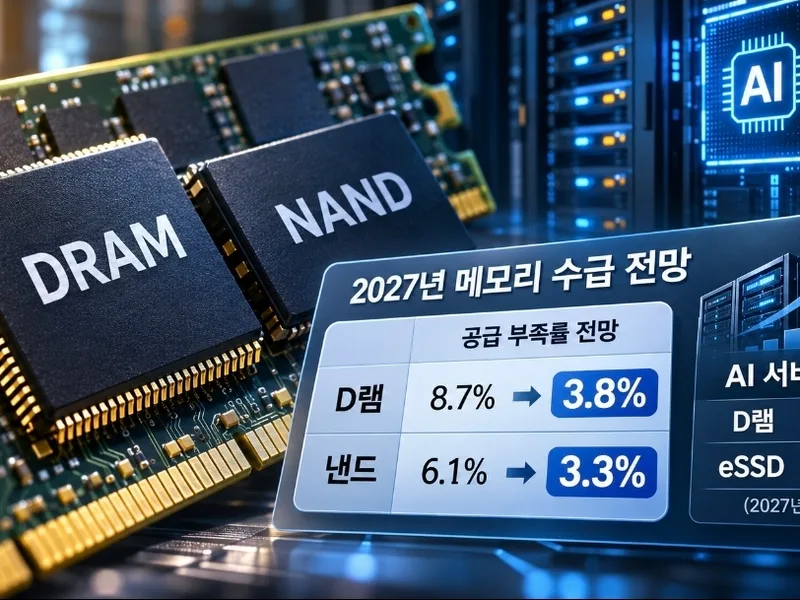
DRAM shortage forecast decreases from 8.7% to 3.8%... NAND also lowered from 6.1% to 3.3%
Demand for memory for AI servers remains strong... Production expansion and slowdown in consumer demand are variables
It is predicted that the global memory semiconductor market will continue to have a supply shortage in 2027. Although the shortage will decrease due to manufacturers' increased production and some slowdowns in demand, the analysis is that demand growth, especially for server memory, will still outpace supply. However, there is a view that NAND supply may exceed demand from the second half of next year, so the trends for each product may vary.
씨티, D램·낸드 공급 부족률 전망 축소…AI 서버 수요는 견조
In the forecast announced on the 3rd (local time), Citi lowered the global DRAM supply shortage rate in 2027 from 8.7% to 3.8%. The forecast for NAND flash supply shortage rate was also lowered from 6.1% to 3.3%. This is the result of raising the supply forecast to reflect the production expansion plans of major memory manufacturers.
Citi predicted that while DRAM supply in 2027 will increase by 24% compared to the previous year, demand will increase by 28%. NAND supply and demand growth rates were expected to be 22% and 26%, respectively. In particular, the forecast for NAND demand growth was lowered from 29% to 26% to reflect sluggish demand for consumer products. The demand forecast for DRAM was also slightly lowered considering the slowdown in demand for smartphones.
On the other hand, demand for memory for AI servers is expected to maintain high growth. Citi predicted that in 2027, demand for server DRAM and enterprise solid-state drive (eSSD) will increase by 53% and 52%, respectively, compared to the previous year.
생산시설 확충에도 공급 제약…HBM 생산 확대도 변수
On the supply side, the time it takes to secure new production facilities is key. In an analysis released on September 17, the U.S. Center for Strategic and International Studies (CSIS) explained that it usually takes more than 2 to 3 years from the construction of a new DRAM production facility to certification and production expansion. Accordingly, even if production capacity is expanded in 2027, the full-scale supply increase effect is likely to occur with a lag. CSIS also suggested that the supply contribution of new production facilities could increase further after 2028.
The expansion of high bandwidth memory (HBM) production is also a factor affecting the supply and demand of general-purpose DRAM. Because HBM and general-purpose DRAM share some manufacturing processes and production resources, if the proportion of HBM production increases, the production capacity that can be distributed to other DRAM products may be limited.
씨티·트렌드포스, 2027년 낸드 수급 전망 차이…가격 향방 주목
In a report released in July, market research firm Trend Force predicted that supply constraints for DRAM would continue due to HBM production capacity distribution and increased demand for AI servers. On the other hand, NAND supply conditions are expected to ease from the second half of 2027 due to the operation of new production capacity and sluggish demand for electronic devices such as smartphones and PCs.
Trend Force predicted that annual NAND supply and demand would return to a supply advantage in 2027, while Citi predicted that supply shortages would continue. However, since the two organizations' forecast announcement times are different in July and November, respectively, it is difficult to conclude that this is a direct conflict of opinion at this time.
Trend Force also suggested the possibility that if demand for SSDs increases faster than expected due to the spread of AI agents, NAND supply and demand may approach balance again. The key to the NAND market is expected to be how much data center investment offsets sluggish demand for personal devices.
Future memory prices are expected to be influenced not only by whether supply shortages persist but also by how quickly the supply-demand gap narrows. The expansion of long-term supply agreements (LTA) is also a factor that changes price trends. Citi analyzed that memory manufacturers are focusing on securing mid- to long-term performance visibility through long-term contracts rather than short-term price increases. Even if supply shortages continue, actual sales price movements may vary depending on transaction conditions and contract structure.
Ultimately, the direction of the global memory market in 2027 depends on the speed of increase in AI-related demand and when new production capacity leads to actual supply. In particular, while the growth of server DRAM and corporate SSD continues, the supply-demand imbalance and price trends for each product are expected to be differentiated depending on how much demand for consumer memory recovers.