


Potential shifts in Nvidia’s production capacity strategy: Opportunities for AMD and Broadcom
Focus on HBM4 pricing and supply priority: Ripple effects from Korean memory to the global equipment industry
The announcement on the 12th (local time) regarding the resignation of Nvidia CEO Jensen Huang and the appointment of CFO Colette Kress as interim CEO is expected to trigger shifts in the global AI semiconductor supply chain. As speculation grows that the advanced production capacity previously secured by Huang—leveraging massive capital and deep supplier relationships—could be redistributed to competitors like AMD and Broadcom, the HBM supply strategies of Samsung Electronics and SK hynix are coming under intense scrutiny.
The Korean Memory and Taiwanese Production Lines Secured by Jensen Huang
While Nvidia designs AI semiconductors, it does not manufacture them directly. Advanced chips are produced by Taiwan’s TSMC, while HBM is supplied by companies such as SK hynix and Samsung Electronics. Given that expanding production lines and increasing HBM output takes years, Nvidia has maintained its market lead by securing long-term supply volumes ahead of its competitors.
According to a quarterly report released by Nvidia in August, commitments related to supply and production capacity reached $279 billion as of July 26, 2026, an increase of $160 billion from the previous quarter. These long-term commitments, covering memory and manufacturing infrastructure for data centers, are subject to adjustment before final orders. Semiconductor research firm SemiAnalysis noted that the increase is primarily linked to memory procurement.
Jensen Huang personally met with executives from key suppliers in South Korea and Taiwan to secure long-term volumes. A Taiwanese supplier executive told Reuters that they are concerned the successor may not be as aggressive in securing capacity as Huang. For companies that have increased capital expenditure in anticipation of Nvidia’s orders, there is now a need to re-evaluate future expansion scales and timelines.
Conversely, new opportunities may open for AMD and Broadcom. Even if these companies aim to expand sales of AI accelerators and custom chips, they cannot increase production without access to TSMC’s advanced processes and HBM. If Nvidia’s preemptive hold on production capacity eases, it could provide more room for competitors to secure supply.
Nvidia’s advantage was not limited to volume; it also influenced the schedules for competitors to secure capacity and launch new products. A weakening of this supply priority could lead to changes in volume allocation and price negotiations for domestic memory manufacturers.
HBM4 Price Disparities: The Choices Facing SK hynix and Samsung Electronics
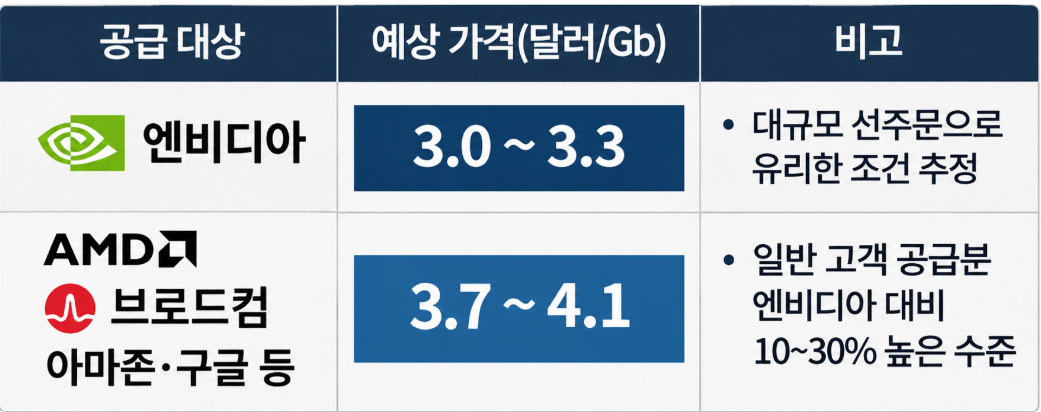
SemiAnalysis estimates that SK hynix’s 2027 HBM4 price for Nvidia will be $3.0–$3.3 per gigabit (Gb), compared to $3.7–$4.1 for other major customers like AMD, Broadcom, Amazon, and Google. While Nvidia likely secured favorable terms through massive orders, direct comparisons are limited as actual contract prices and product specifications remain undisclosed.
 SemiAnalysis suggests an implicit relationship where Nvidia prioritizes GPU allocation to the SK Group in exchange for priority in HBM supply. While unconfirmed, this indicates that their cooperation may have expanded beyond memory supply into the broader AI infrastructure.
SK hynix has no immediate reason to divert Nvidia’s supply to other customers, given existing long-term contracts and Nvidia’s status as the largest supplier in the AI accelerator market. However, as orders from AMD and Big Tech for proprietary AI chips grow, the room for negotiating prices and supply conditions during future capacity allocations will increase.
Samsung Electronics may also find opportunities for customer diversification. While a shift away from Nvidia-centric orders toward various AI chip developers favors expanding the client base, securing actual orders will require proven mass-production capabilities and customer certification.
A weakening of Nvidia’s supply priority does not imply a decline in HBM demand. For suppliers, the focus may shift from how much to sell to their largest customer to how to allocate increasing production volumes among various clients at optimal prices.
From Taiwanese Production Lines to Global Equipment Industries
TSMC produces advanced semiconductors for AMD and Broadcom alongside Nvidia. Even if Nvidia reduces its new capacity procurement, the impact on factory utilization rates may be limited if competitor orders fill the gap. However, if AI infrastructure investment itself slows, competition for production lines could take a different turn.
Jensen Huang was actively involved not only in large-scale supply contracts but also in next-generation product development and customer AI infrastructure investments. TF International Securities analyst Ming-Chi Kuo told Reuters, "Jensen Huang is a figure who can turn technologies that engineers think are feasible into products that the entire company must commit resources and take risks to complete."
This investment flow also affects companies like Japan’s Advantest and Tokyo Electron, and the Netherlands’ ASML. While continued expansion by semiconductor manufacturers leads to orders for inspection, manufacturing, and lithography equipment, delays in investment schedules could adjust the timing of equipment orders. Currently, no cancellations or contract changes have been confirmed for these firms.
The financial support Nvidia has provided to AI companies and data center operators is also linked to the broader supply chain. Neil Shah, Vice President at Counterpoint Research, explained to Reuters that aggressive ecosystem investment and large-scale AI infrastructure cooperation could slow down following Huang’s departure.
On the other hand, Armina Rosenberg of Minotaur Capital, an Nvidia shareholder, noted that semiconductors to be supplied over the next 1–2 years are already in the design and production stages, and customer investment plans for 2027 are not dictated by a CEO change. Nvidia’s board also stated it expects no disruption to company operations, customer commitments, or product development schedules.
In reality, demand for AI servers remains robust. Taiwan’s Foxconn reported a 34% year-on-year increase in net profit for the third quarter on the 12th and expects high double-digit growth in AI server rack shipments through 2027. Foxconn Chairman Young Liu predicted that shortages of key components, including semiconductors and memory, will persist into next year.
Even if Nvidia turns passive in securing new capacity, the likelihood of oversupply remains low if AMD, Broadcom, and Big Tech companies developing their own AI chips absorb that volume. Conversely, if AI infrastructure investment itself slows, customer diversification alone will not be enough to offset the decline in demand.
There is a fundamental difference between Nvidia’s volume shifting to other customers and the AI semiconductor market itself shrinking. The future bargaining power of SK hynix and Samsung Electronics will likely hinge on this distinction.