


Earnings Projections Up 35% While Stock Prices Fall 45%
Forward P/E Drops to 3.5x… AI Companies Face Escalating Debt and Repayment Pressures
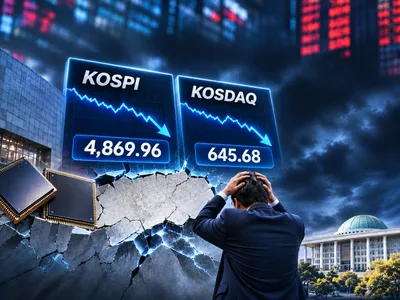
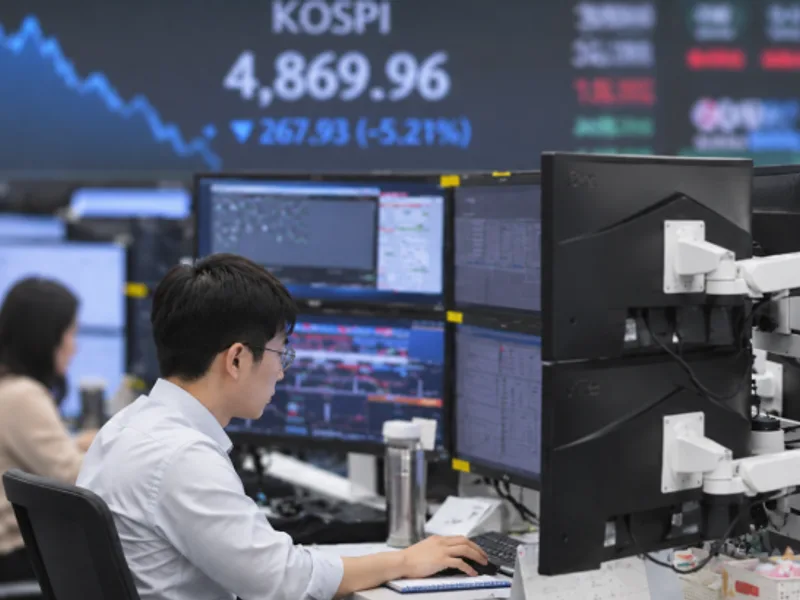
The KOSPI index, which plunged more than 5% on the 20th, extended its losses on the 23rd, slipping toward the 4,700 level. While corporate earnings forecasts are rising steeply, brokerage firms have raised downside scenarios, with some arguing for support at the 4,300 level and others warning of a worst-case fall to the 4,000 mark. The ability to secure financing to manage massive capital expenditures has emerged as a new market variable, overshadowing the growth potential of the artificial intelligence (AI) industry.
Strong Earnings, Falling Stocks: What's Driving the Disconnect?
According to Daishin Securities, while the KOSPI tumbled 45.5% from its peak last June, 12-month forward earnings per share (EPS) actually increased by 35.2%. Yuanta Securities also analyzed that the KOSPI's 12-month forward price-to-earnings (P/E) ratio dropped from 10.2x at the beginning of the year to 3.5x.
Despite higher corporate profit outlooks, stock prices have been nearly halved. Buying momentum has failed to recover even with diminished valuations. The core issue is whether the earnings outlook for the semiconductor sector, which has driven KOSPI profit growth, can be sustained going forward.
Han Ji-young, an analyst at Kiwoom Securities, noted, "What makes this sharp downturn more challenging is that it occurred without any damage to earnings consensus." She added, "The market appears to be preemptively pricing in expectations that the semiconductor-centric KOSPI earnings consensus could experience a sharp downward revision of over 50%."
Support at 4,300 vs. Threat of 4,000: Brokerages Divided on Outlook
As the index repeatedly breaches key support levels, brokerage firms have projected KOSPI floors ranging widely from 4,000 to 4,800. Calculations for the market bottom vary significantly despite analyzing the same index.
Samsung Securities suggested 4,300 as a strong support line. On the 20th, the KOSPI's 12-month forward price-to-book ratio (PBR) stood at 0.95x, falling below the 20-year average of 1.08x. Samsung Securities calculated the index floor at the 4,300 level by applying a PBR of 0.86x, subtracting a standard deviation of 0.22x.
Yang Il-woo, an analyst at Samsung Securities, stated, "Even if the KOSPI faces downward pressure, we expect it to bottom out around the 4,300 level. While there are short-term supply and demand pressures, we must not overlook the valuation aspect."
Kiwoom Securities estimated that in the worst-case scenario, the index could fall to the 4,200–4,300 range, corresponding to a forward PBR of 0.8x. However, considering historical overselling and the potential deployment of a market stabilization fund, it rated the likelihood of this scenario as low and recommended maintaining current holdings.
KB Securities presented a lower downside scenario. Based on the KOSPI closing price on the 20th, the PBR was calculated at 1.20x; applying historical valuation declines after bull markets yields 4,464 at a PBR of 1.10x and 4,058 at 1.00x. The 4,000 level is not a baseline target but rather a scenario assuming extreme deterioration in investor sentiment.
Additionally, Hana Securities projected potential further adjustments down to the 4,300 level based on trailing PBR, while Daishin Securities pointed to statistical lows of 4,500–4,600 based on past market crash statistics. Shinhan Securities analyzed the appropriate floor at around 4,800, under the premise that corporate earnings forecasts remain intact.
Because brokerage firms apply different PBR calculation standards and market assumptions, direct comparisons remain difficult. While Samsung Securities presented 4,300 as a support line, Kiwoom and KB Securities left their lower bounds open to account for harsher market conditions.
$1.19 Trillion in AI Investments: Growing Borrowing Pressures
Even with improving earnings forecasts, brokerage firms are leaving room for further declines due to the borrowing burdens of AI companies. Even if industry growth projections hold up, deteriorating financing conditions could undermine investment capacity and profitability.
According to Bloomberg consensus, capital expenditures (CAPEX) by the world's top five big tech companies (hyperscalers) are projected to surge 49% from this year to reach $1.19 trillion by 2027. Market perceptions of these astronomical investment plans are shifting. How these funds will be raised and repaid has become more critical than the sheer volume of investment.
In a report released today, DB Securities diagnosed the current phase as an "AI credit re-rating" stage. Following the peak of AI-related stocks in early October, market focus has shifted from growth and profitability to actual debt scales and repayment burdens. In particular, the firm warned of credit risks among companies with high debt dependency, such as Oracle and CoreWeave.
Debt maturities for AI-related companies concentrated from 2027 and redemption pressures in the private credit market also pose burdens. If rising interest rates increase refinancing costs, additional facility investments could be constrained. Kiwoom Securities similarly cited cash flow deterioration driven by delayed AI monetization and widening credit spreads as major risk factors.
If financing setbacks among U.S. AI companies lead to reduced investments in data centers, the demand base for Samsung Electronics and SK hynix, which supply high-bandwidth memory (HBM), will also weaken. Even if the growth outlook for the AI industry remains intact, a slower investment pace will inevitably impact the earnings estimates of domestic semiconductor firms.
Samsung Securities assessed that the recent slump in AI and semiconductor stocks has limited potential to undermine long-term AI growth prospects. It also suggested that as market concentration around Nvidia eases, opportunities could emerge for domestic semiconductor companies expanding their HBM exposure.
For the KOSPI's undervalued appeal to translate into an actual rebound, corporate earnings forecasts must hold steady. If financing issues among AI companies escalate into reduced facility investments, the current low P/E ratio will offer little solid ground for support.
Park Sung-woo, an analyst at DB Securities, diagnosed, "Although the adjustment in AI asset prices has deepened, we do not view this as an AI cycle collapse or a credit crisis. The current phase is an 'AI credit re-rating' period where risk management has become paramount."