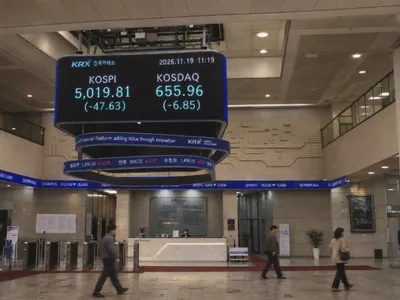


On the day the KOSPI plunged 5.21%, KRX spot gold also fell 4.17%.
Real yields on 10-year Treasury Inflation-Protected Securities (TIPS) hit their highest since 2002; the December dot plot remains a key variable.
On the 20th, when the KOSPI plummeted by more than 5%, gold—typically regarded as a safe-haven asset—declined alongside equities. Gold prices were pressured by a strengthening US dollar and expectations of further Federal Reserve rate hikes, while rising US Treasury real yields since the beginning of the year added to the burden on non-yielding gold. This explains why tracking the US bond market is just as crucial as monitoring the gold market to gauge gold price trends.
On the Korea Exchange (KRX) gold market, spot gold closed down 4.17% from the previous trading session at 153,090 won per gram. International spot gold dropped during intraday trading to its lowest level since September 2025, trading at $3,552 per ounce as of 4:30 p.m. Korea time. This marks a 36.5% decline from its intraday peak on January 29 ($5,595) and a 17.7% drop from its closing price at the end of last year ($4,315).
Gold generates no income while held. As the yields on bonds that offer inflation-adjusted returns rise, the opportunity cost of holding gold increases. At a $19 billion auction of 10-year Treasury Inflation-Protected Securities (TIPS) held on the 19th (local time), the winning real yield was recorded at 2.903%, the highest for a 10-year auction since July 2002. This means that based on the winning price, the annualized inflation-adjusted return until maturity is approximately 2.9%. The 10-year real yield traded in the secondary market also stood at 2.88% on the 19th, up 0.94 percentage points from January 2nd (1.94%) and approaching its yearly peak of 2.95% recorded on October 5th.
This shift is not readily apparent by looking at nominal yields alone. According to data from the US Department of the Treasury and the Federal Reserve Bank of St. Louis (FRED), the 10-year nominal yield remained virtually flat at 5.05% on October 28 and 5.04% on November 19. However, over the same period, market-based inflation expectations dropped from 2.38% to 2.16%, while real yields climbed from 2.67% to 2.88%. Consequently, while nominal yields remained unchanged, the burden on gold increased over the span of three weeks.
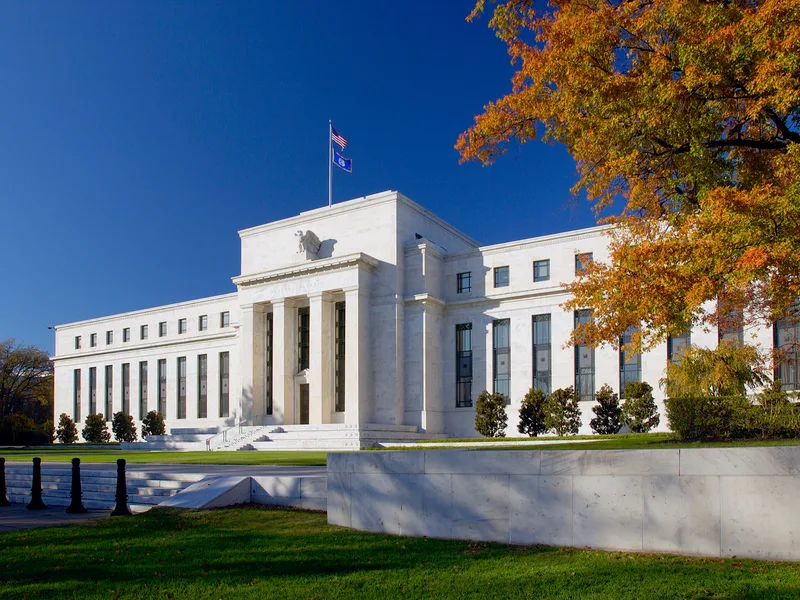
Over the same period, expectations for additional rate hikes by the Federal Reserve (Fed) also strengthened. Although the Fed kept its benchmark interest rate steady at 3.75% to 4.00% in October, the meeting minutes indicated that nearly all participants deemed further rate hikes likely appropriate if inflation and employment evolve as expected. According to the CME FedWatch Tool, the probability of a 25-basis-point rate hike in December reached 99.3% on the 20th. The US dollar index also approached a 19-month high. A stronger dollar increases the burden for investors purchasing gold in other currencies.
The pressure from rising real yields extends to domestic investors as well. Higher real yields elevate discount rates, lowering the present value of future corporate earnings and placing a burden on growth stocks. Perspectives on gold have also shifted. While gold is often utilized as a hedge against equity market declines, in an environment of rising real yields, stocks and gold can fall in tandem, as witnessed on this day.
When this pressure will ease depends on the trajectory of interest rates next year, which will be dictated by inflation and employment trends. Artificial intelligence (AI) investments are frequently cited as a variable capable of driving inflation. Austan Goolsbee, president of the Federal Reserve Bank of Chicago, who holds a vote on the Federal Open Market Committee (FOMC) next year, noted in a speech at the Economic Club of Indiana on the 19th (local time) that massive data center investments could boost demand and overheat the US economy. Meanwhile, US nonfarm payrolls increased by 165,000 in October, beating market expectations, while the unemployment rate ticked down to 4.1%.
With a December rate hike largely priced into the market, attention has shifted to whether hikes will continue next year. The next key economic indicator will be the US Personal Consumption Expenditures (PCE) price index for October, scheduled for release at 10:30 p.m. Korea time on the 25th. Subsequently, the Fed will release its dot plot outlining next year's benchmark rate projections during the FOMC meeting on December 8–9 (local time). If expectations for additional rate hikes next year soften through these two releases, causing both real yields and the dollar to pull back, the downward pressure on gold prices could subside. Conversely, if expectations for further hikes persist and real yields and the dollar remain elevated, headwinds for gold prices are likely to continue.