Despite a 76% growth in the electric passenger vehicle market, imports now account for over half of sales, with Tesla registrations surging 105%.
Chinese manufacturers are pivoting to Korea due to domestic stagnation and trade barriers in the US and EU, highlighting an urgent need to support local production and the parts industry.
The market share of domestic vehicles in the South Korean electric passenger car market fell below 50% in October, continuing a trend observed in September. As demand for electric vehicles (EVs) spikes, the expansion of imports—specifically Tesla models from China and brands like BYD—has pushed foreign vehicles to capture more than half of the market.
Given China's domestic economic downturn and the high tariff barriers imposed by the US and Europe, the offensive by Chinese automakers into the Korean market is expected to intensify. This underscores the urgent need for countermeasures to protect domestic production bases and the automotive parts industry.
EV Market Grows 76%… Domestic Share at 49.2%
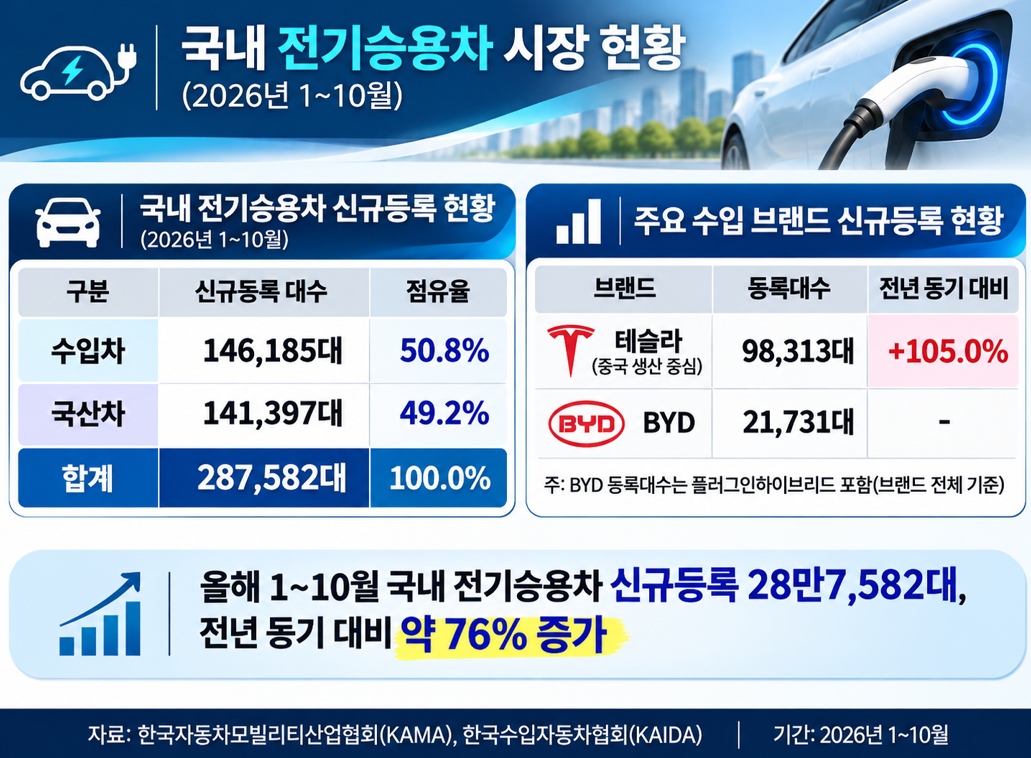
From January to October this year, new registrations for electric passenger vehicles in Korea reached approximately 288,000, a 76% increase from the 164,000 recorded during the same period last year. During this timeframe, imported EVs accounted for 50.8% of the market with 146,185 units, while domestic vehicles lagged at 49.2% with 141,397 units.
 The expansion of Chinese-made Tesla vehicles and BYD has been particularly notable in the import segment.
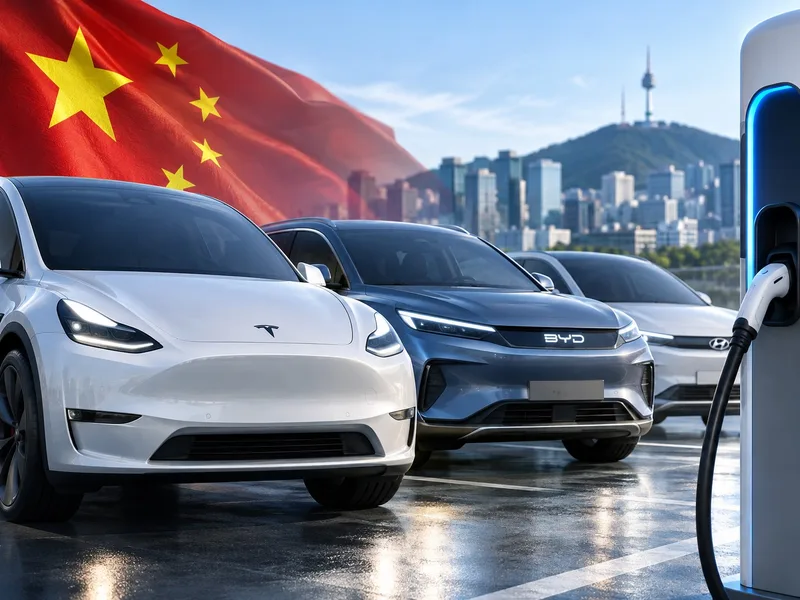
According to the Korea Automobile Importers & Distributors Association (KAIDA), new registrations for Tesla from January to October reached 98,313, a 105.0% surge compared to the same period last year. The Model Y, produced at the Shanghai Gigafactory, led sales with 78,631 units, while the Chinese brand BYD recorded 21,731 units.
With Zeekr having already launched in Korea and other brands like Xpeng and Chery planning entries, the influence of Chinese automakers is poised to expand further.
The deterioration of the trade balance is also evident. The automotive trade deficit with China reached approximately 6 trillion won from January to October, an increase of over 90% compared to the same period last year, driven by a 79.2% rise in imports and a 34.9% decline in exports.
China's Domestic Sales Drop 13%, Exports Jump 140%… Focus on Korea's 8% Tariff
The aggressive expansion of Chinese automakers into overseas markets is rooted in domestic stagnation and excess production capacity.
According to the China Passenger Car Association (CPCA), domestic sales of new energy passenger vehicles in China fell by 12.9% to approximately 8.87 million units from January to October, while exports surged by 139.7% to about 4.47 million units.
As Chinese firms compensate for weak domestic demand by ramping up exports, South Korea is viewed as a market with lower entry barriers compared to other major developed economies.
Korea’s base tariff rate for passenger cars is only 8%, whereas the US imposes tariffs of up to 127.5% on Chinese EVs, and the European Union applies tariffs of up to 45.3%.
Furthermore, Chinese firms have secured price competitiveness based on large-scale production facilities and robust battery supply chains. As domestic stagnation in China and trade barriers in major nations persist, the push into the Korean market is likely to accelerate.
Beyond Subsidies: Supporting Domestic Production
The influx of Chinese EVs poses a threat not only to domestic automakers but also to the parts industry.
According to the Ministry of Trade, Industry and Energy, domestic sales by local automakers fell by 7.2% to 1,043,729 units from January to October, while imported car sales rose by 23.3% to 325,542 units.
The National Assembly Budget Office noted on the 16th that over 4 trillion won is spent annually on EV purchase subsidies, charging infrastructure, and tax breaks, suggesting a need to reform the current subsidy-centric support model.
The domestic automotive industry is calling for the inclusion of finished EVs in domestic production tax credit schemes. Although relevant bills have been proposed in the National Assembly, the Ministry of Economy and Finance stated on the 20th that a decision on their implementation has not yet been reached.
In addition to tax incentives to encourage domestic production, support for R&D and facility investment is essential to help parts manufacturers transition to electrification. Automakers must also strengthen their competitiveness in pricing, battery technology, and software.
However, a cautious approach is required, as raising tariffs could lead to trade friction and increased burdens on consumers.