


Margin trading regulations eased after 10 months; up to 80 trillion won in additional buying capacity expected.
Margin loan balances down 27%; People's Bank of China liquidity support and transaction cost cuts implemented in parallel.
China is easing margin trading regulations for the first time in 10 months in response to a sharp decline in its stock market. By lowering the margin requirement—which was raised earlier this year to curb overheating—authorities aim to secure up to 400 billion yuan (approximately 80 trillion won) in additional buying capacity.
According to reports from Xinhua News Agency and Reuters on the 23rd, China's three major stock exchanges in Shanghai, Shenzhen, and Beijing announced on the 22nd (local time), with approval from the China Securities Regulatory Commission (CSRC), that the minimum margin requirement for margin purchases will be reduced from 100% to 80%. The new rules will take effect on the 30th.
Margin trading involves borrowing funds from brokerage firms to purchase stocks. Lowering the margin requirement allows investors to purchase more shares with the same collateral. For example, the purchasing power of 1 million yuan in margin would increase by 25%, from 1 million yuan to 1.25 million yuan.
Chinese authorities had raised the margin requirement from 80% to 100% in January to suppress leveraged investment, but have now reversed the policy following the recent market slump.
Tech stocks fall over 40%; margin loan balances drop 27%
According to Reuters, the Shanghai Composite Index fell about 3% last week to its lowest level in 16 months. Major indices on the Shanghai STAR Market and the Shenzhen ChiNext have plummeted more than 40% from their June highs.
Margin trading has also contracted alongside falling stock prices. The balance of margin loans in the Chinese stock market has decreased by approximately 27%, from about 3 trillion yuan at the end of June to 2.2 trillion yuan recently.
The three major Chinese exchanges explained that margin trading activity has significantly shrunk and overall market leverage levels are not high. The move is intended to improve market liquidity and expand investors' capital utilization capacity.
This regulatory easing applies to both new trades and existing margin contracts. The Economic Information Daily estimates that this could generate up to 400 billion yuan in additional buying capacity, including approximately 100 billion yuan from new trades and 300 billion yuan from the recalculation of margins on existing contracts. This represents a theoretical maximum rather than actual capital injection.
Market rebound remains limited despite PBOC support; transaction costs reduced
Earlier this month, the People's Bank of China (PBOC) implemented a 100 billion yuan swap facility for securities, fund, and insurance companies and lowered the relending rate for share buybacks from 1.25% to 1%. However, the market rebound has been limited by ongoing economic slowdown and a global sell-off in artificial intelligence (AI) related stocks.
Alongside the easing of margin rules, China is also pushing for reforms in trading systems. The Shenzhen Stock Exchange has released a draft rule to introduce a market maker system for the ChiNext board, while the Shanghai and Shenzhen exchanges have decided to further reduce transaction fees to lower the burden on investors.
Tian Lihui, a professor at Nankai University's School of Finance, told the Economic Information Daily, "Lowering the margin requirement from 100% to 80% is a precise counter-cyclical adjustment. While the ratio was raised earlier this year to prevent overheating, the current environment of shrinking trade and low leverage justifies returning that capacity to the market."
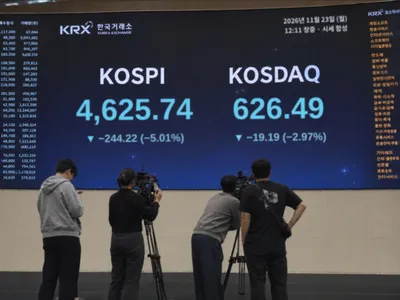
China's regulatory easing comes amid a series of market stabilization measures in major Asian markets, including South Korea and Taiwan. Unlike Taiwan, which has tightened short-selling regulations, China has chosen to lower the threshold for margin trading to stimulate buying demand.
Given lingering concerns over the economy and corporate earnings, it remains uncertain how much buying interest will actually recover. If stock prices continue to fall after an increase in margin trading, the risk of forced liquidation will also rise. The changes in margin loan balances and trading volume following the implementation on the 30th will be key indicators of the effectiveness of these measures.