


Brokerages highlight the expansion of Samsung's robotics ecosystem; Rainbow Robotics reports 44% of revenue from Samsung.
Adopting a direct-drive system with 20 motors per hand, Samsung creates opportunities for micro-reducer and precision component suppliers.
As Samsung Electronics' humanoid development gains momentum, the focus of the financial sector is shifting from finished robotics to key component suppliers. Unlike Hyundai Motor Group, which can leverage its existing automotive supply chain, Samsung Electronics is likely to identify new partners throughout its development and mass-production phases. This opens market entry opportunities for component manufacturers that were previously overlooked in the robotics supply chain.
On the 25th, iM Securities and Eugene Investment & Securities released reports analyzing Samsung Electronics' current humanoid development status and the potential for expanding its mass-production supply chain. This follows reports that Samsung Electronics is expected to unveil its self-developed bipedal humanoid at CES 2027, the world's largest IT and consumer electronics exhibition, held in Las Vegas next January.
Internal momentum at Samsung Electronics is also accelerating. During the executive reshuffle on the 20th, President Roh Tae-moon stepped down from his concurrent role as head of the Mobile Experience (MX) division but retained his position as head of the Robot Business Task Force (RX). In the subsequent executive appointments on the 24th, Hyung Seung-yong, head of the Robotics System Group, and Koo Dong-han, head of the Physical AI Lab, were both promoted to vice president.
Deepening Cooperation with Rainbow Robotics Despite Concerns Over Independent Development
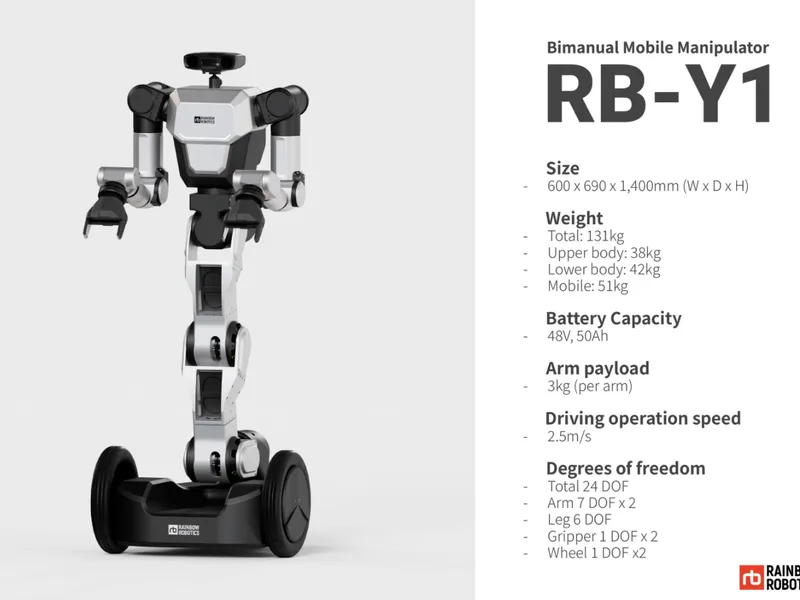
Some market observers have expressed concerns that Samsung Electronics' direct development of humanoids could diminish the standing of its subsidiary, Rainbow Robotics. However, recent performance data and inter-affiliate business cooperation suggest that the synergy between the two companies is actually expanding.
According to iM Securities, Rainbow Robotics recorded 13.91 billion KRW in revenue for the third quarter of this year, with 6.12 billion KRW (44%) coming from Samsung Electronics. Notably, a significant portion of these transactions was recognized as service revenue rather than product sales.
Lee Sang-soo, an analyst at iM Securities, believes that as Samsung Electronics focuses its internal development resources ahead of CES 2027, the role of Rainbow Robotics will likely evolve into a collaborative development partnership.
Business cooperation within the group is also on the rise. On the 18th, Miracom Inc., a subsidiary of Samsung SDS, announced a joint initiative with Rainbow Robotics to supply robots and promote the Robotics Transformation (RX) of manufacturing sites. The scope of cooperation has expanded beyond hardware supply to include the integration, construction, and operation of manufacturing systems.
Samsung Electronics plans to transition its domestic and international production bases into AI-driven autonomous factories by 2030, gradually integrating robots into all manufacturing processes. In Gumi, North Gyeongsang Province, the company is investing 19 trillion KRW alongside Samsung SDS to build a humanoid mass-production facility, a smartphone manufacturing innovation hub, and an AI data center.
A key strength for Samsung Electronics is its ability to verify robot performance on its own production lines and accumulate operational data from real-world manufacturing processes before external commercialization.
Why Samsung is Focusing on Robotic Hands
The most notable feature of Samsung's humanoid is its "dexterous hand," capable of performing tasks as precise as human hands. According to known specifications, Samsung is pursuing a direct-drive method, equipping each hand with 20 motors for a total of 40 per robot.
The cable-driven method used in Tesla's Optimus utilizes actuators in the arm to pull cables like human tendons to move the fingers. While this is advantageous for reducing the weight and volume of the hand, the cables can wear out and lose durability during long-term repetitive tasks.
Conversely, the direct-drive method places actuators directly at each finger joint, offering superior precision in force control and durability for repetitive motions. While this increases costs and volume, it is better suited for high-difficulty manufacturing processes such as smartphone assembly.
If Samsung Electronics prioritizes precision and durability over cost, the quantity and technical requirements for components in the robotic hand will increase. The financial sector is closely watching manufacturers of micro-motors, reducers, and precision metal components.
Yuanta Securities also noted last month that Samsung Electronics is likely to use precise hand-manipulation technology as a key differentiator against competitors, expanding its robotics business based on data secured from its own manufacturing processes.
A Different Supply Chain from Hyundai Motor: Potential for New Entrants
The most distinct difference between the humanoid strategies of Hyundai Motor Group and Samsung Electronics lies in their procurement methods.
Hyundai Mobis announced at CES 2026 in January that it would supply actuators—the core driving components—in line with the mass production of Boston Dynamics' "Atlas" humanoid. The group can leverage decades of mass-production expertise in automotive parts and its existing network of suppliers for its robotics business.
In contrast, Samsung Electronics does not possess a comparable supply chain for driving components. Even if it designs the robotic hands and actuators in-house, it does not necessarily need to manufacture every sub-component itself. Samsung's relative weakness in this area presents a new market entry opportunity for specialized external component manufacturers.
Analyst Lee noted, "Samsung Electronics' humanoid supply chain has a higher probability of new entrants compared to Hyundai Motor Group."
iM Securities identified companies such as SPG, which supplies reducers to Rainbow Robotics, along with Wonik Holdings, Korea PIM, and KH Vatec as potential beneficiaries. Wonik Holdings owns the robotic hand developer Wonik Robotics, while Korea PIM and KH Vatec possess capabilities in manufacturing precision small components.
Eugene Investment & Securities also emphasized the need to verify the technical maturity, mass-production supply chain, and commercialization plans of Samsung's humanoid at CES 2027. While the upcoming CES will provide a glimpse into Samsung's robotics development level, the actual impact on the domestic component industry will only become clear once the scale of mass production and external order volumes are revealed.