
October employment rises by 139,000; growth driven by those aged 60 and older and those in their 30s.
Youth employment declines for 48th straight month; employment rate hits six-year low amid slump in hospitality and food services.
The number of employed people in South Korea rose by 139,000 last month compared to a year ago. While total employment maintained a growth trend in the 100,000 range for four consecutive months, the situation for the youth demographic was starkly different. The number of employed youth fell by 196,000, and the employment rate dropped to levels last seen during the early stages of the COVID-19 pandemic.
According to the 'October 2026 Employment Trends' report released by the National Data Agency on the 11th, the number of employed individuals aged 15 and older reached 29.179 million in October, an increase of 139,000 from the same month last year.
By age group, the number of employed individuals aged 60 and older increased by 196,000, while those in their 30s rose by 128,000. Conversely, the number of employed youth aged 15 to 29 fell by 196,000, marking 48 consecutive months of decline. The youth employment rate stood at 42.9%, down 1.7 percentage points from a year ago, the lowest for an October since 2020 (42.3%).
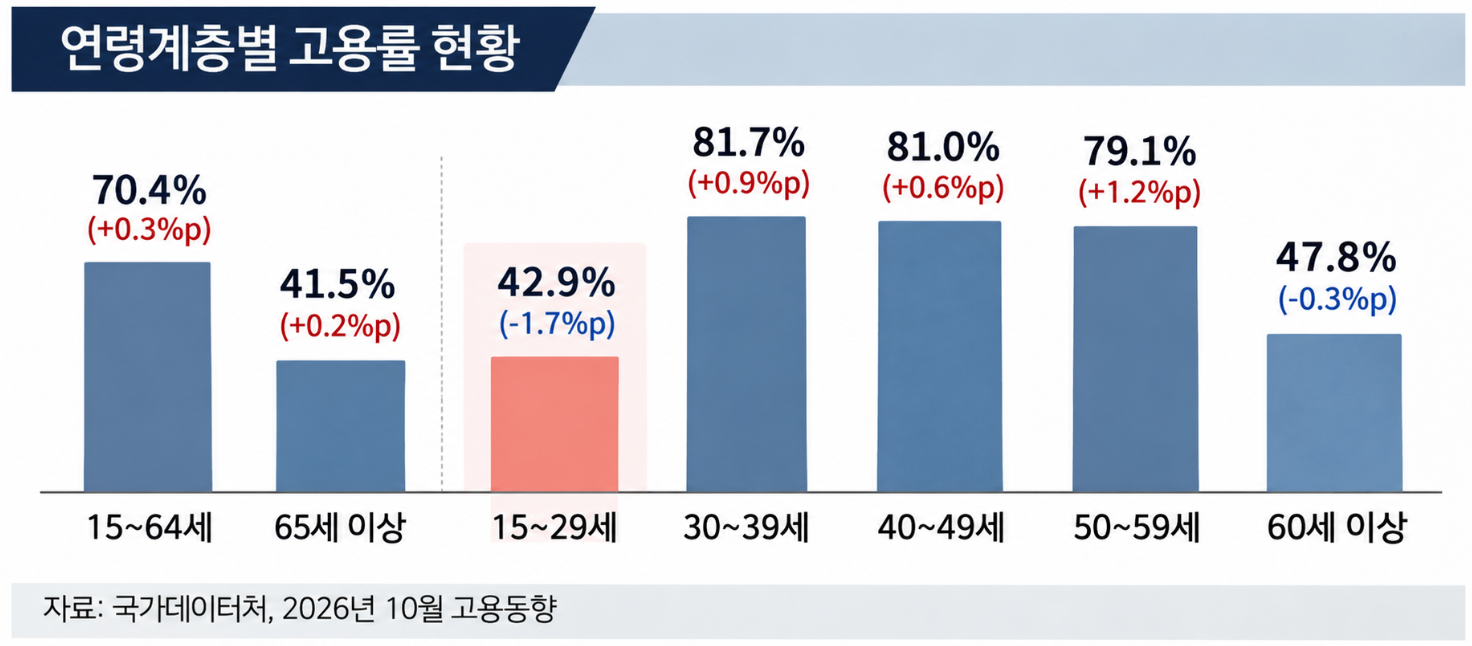 While a shrinking youth population is a contributing factor, it does not fully explain the trend. The youth population in October decreased by 141,000 compared to last year, but the number of employed youth fell by 196,000—a decline 55,000 greater than the population drop. The youth employment rate has now fallen for 30 consecutive months.
Employment conditions in sectors heavily reliant on young workers were also poor. The number of employed individuals in the hospitality and food service sectors fell by 137,000, the largest decline since February 2021. These industries are common entry points for young people seeking part-time work or their first jobs.
Corporate hiring practices may also be impacting youth employment. As large-scale open recruitment is replaced by rolling recruitment, the preference for experienced workers has intensified. However, it is difficult to quantify the exact impact of these shifting hiring practices based on current employment statistics alone.
There were also significant disparities by industry. Employment in the healthcare and social welfare services sector increased by 249,000, exceeding the total employment growth of 139,000. In contrast, manufacturing employment fell by 7,000, returning to a downward trend after one month, and the construction sector saw a decline of 42,000.
The Ministry of Employment and Labor announced plans to develop a 'National Jobs Project' to improve employment conditions for vulnerable groups, including the youth and the elderly.
Although total employment has increased, jobs for the youth are disappearing at a rate faster than the population decline. While those aged 60 and older and those in their 30s drive employment growth, the youth employment rate has been in decline for 30 months.