


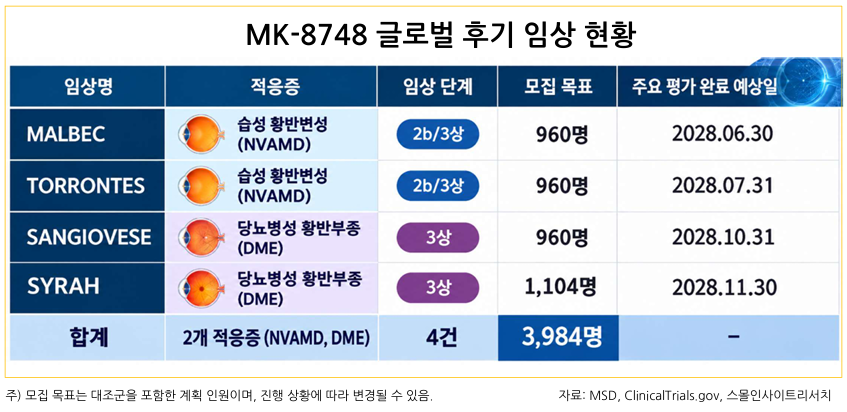
MSD conducting four global late-stage clinical trials for MK-8748 with a target enrollment of 3,984 patients.
Dual-action TIE2 activation and VEGF inhibition aim for 'Best-in-Class' status.
Development milestones reach $10 million in 2026; focus shifts to future royalties and additional payments.
Small Insight Research stated on the 13th that for Ingenia Therapeutics (950260), the focus of valuation is shifting from the scale of licensing agreements to clinical performance and actual royalty inflows, as MSD conducts four global late-stage clinical trials for the ophthalmic candidate MK-8748.
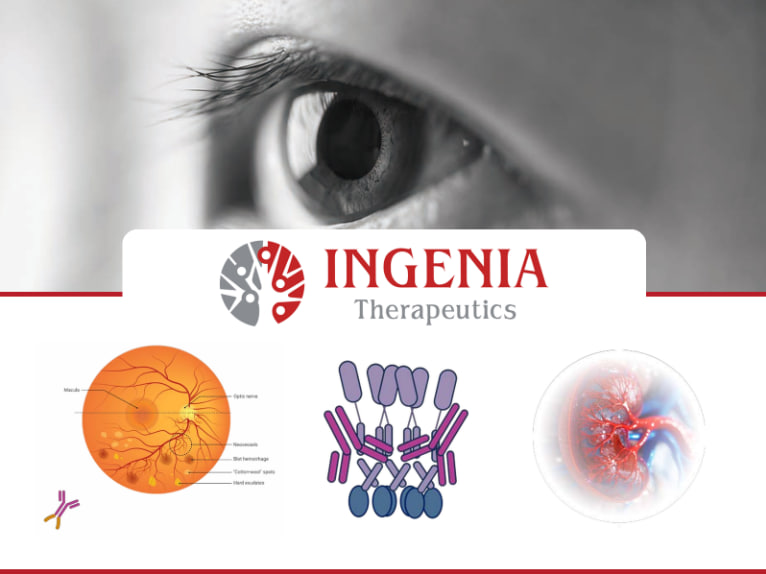
Ingenia Therapeutics is a biotech firm specializing in vascular normalization technology for ophthalmic and renal diseases. In 2022, it licensed out the preclinical ophthalmic candidate IGT-427 to EyeBio, which was subsequently acquired by MSD in 2024, integrating the asset into the global pharmaceutical giant's development pipeline.
Currently, MSD is conducting two Phase 2b/3 trials for wet age-related macular degeneration (wAMD) and two Phase 3 trials for diabetic macular edema (DME). The total enrollment target is 3,984 patients, with primary completion expected between June and November 2028.
 MK-8748 is a bispecific antibody that combines direct TIE2 receptor activation with VEGF inhibition. Unlike existing treatments such as Eylea (VEGF inhibition) or Vabysmo (VEGF/Ang-2 dual inhibition), its differentiator is the direct activation of TIE2 to enhance vascular stability.
In the initial RIOJA clinical trial, 20 treatment-naive wAMD patients showed an average visual acuity improvement of 7.8 letters and a 218㎛ reduction in central retinal thickness at 12 weeks. While superiority over existing treatments has not yet been proven, these are considered positive early efficacy signals. The ongoing late-stage comparative trials against Eylea 2mg are critical for proving efficacy, durability, and the potential for extended dosing intervals, which are key to achieving 'Best-in-Class' status.
Clinical progress is directly translating into revenue. Ingenia Therapeutics recognized $5 million in development milestones in the first half of this year following the initiation of late-stage wAMD trials, and issued an invoice for an additional $5 million in September for the start of the Phase 3 DME trials. With $10 million in milestones confirmed this year, analysts suggest monitoring future development/regulatory milestones and post-commercialization sales royalties.
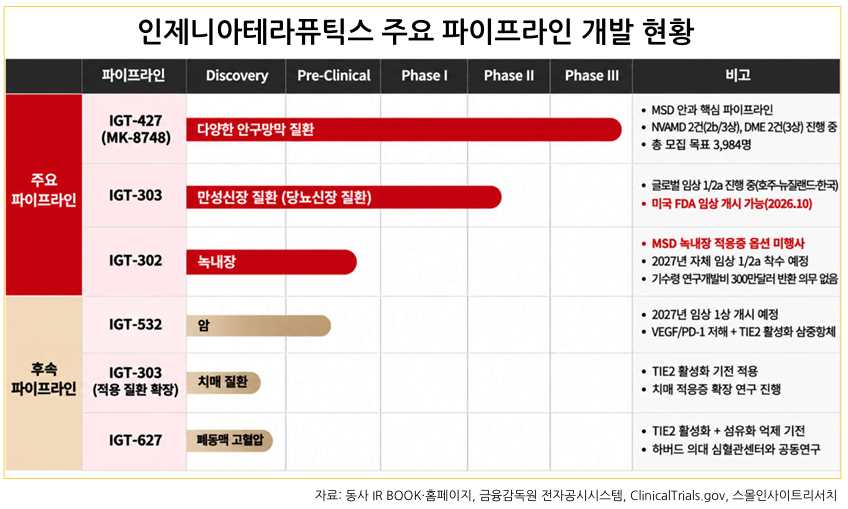 The chronic kidney disease candidate IGT-303 is identified as a secondary growth engine. It demonstrated a 58% reduction in the urine albumin-to-creatinine ratio (UACR) in primate preclinical studies and is currently in early-stage trials in South Korea, Australia, and New Zealand. In October, the company received clearance to initiate Phase 1/2a trials in the U.S. and is pursuing further licensing deals with global pharmaceutical companies.
Regarding the glaucoma candidate IGT-302, Ingenia will pursue independent development following MSD's decision on November 9 not to exercise its option for the indication. The existing licensing agreement for MK-8748 remains intact, and there is no obligation to return the $3 million in joint research and development funds already received. The company expects to spend approximately $10 million (13.6 billion KRW) on its own Phase 1/2a trials, targeting a 2027 start and 2028 completion, with a strategy to re-license the asset to a global pharma partner after securing human data.
Small Insight Research identified key risks including potential clinical failure, safety issues, lack of competitiveness against existing treatments, changes in partner development strategies, delays in milestone payments, and the financial burden of independent clinical trials.
Researcher Choi Sung-won noted, "What we are focusing on is not just the investment amount in late-stage trials, but the continuity and scope of development. The key to future revaluation lies in whether the late-stage clinical results lead to successful commercialization and sustainable cash flow for the company, beyond the scale of MSD's investment."