1.0477 trillion won net bought in four major leveraged ETFs from Nov 2-9; 663.1 billion won concentrated on Nov 5-6.
Forced liquidations reach 5.1903 trillion won this year; market reflects a tug-of-war between forced selling pressure and rebound expectations.
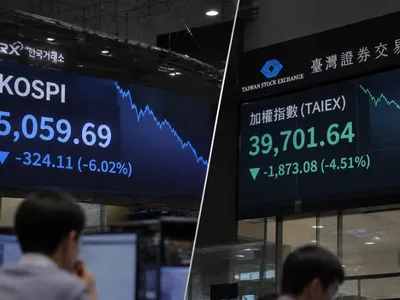
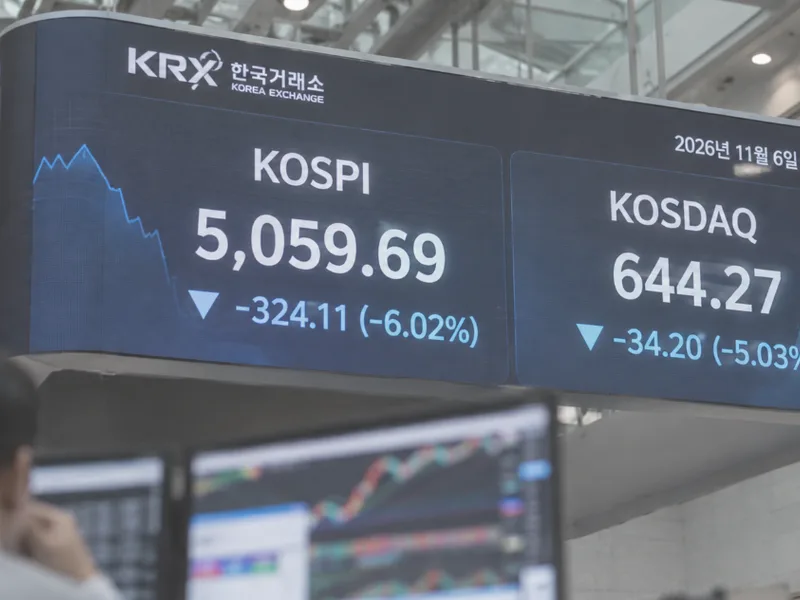
The domestic stock market is experiencing extreme volatility, characterized by a clash between forced liquidation pressures and aggressive buying aimed at a rebound. While forced liquidations from margin trading have surpassed 5 trillion won this year, retail investors have poured over 1 trillion won into major leveraged exchange-traded funds (ETFs) over the past six trading sessions, signaling a high-risk bet on a market recovery.
Market Times data from the Korea Exchange shows that between November 2 and 9, retail investors net purchased 1.0477 trillion won across four major leveraged ETFs. Buying was particularly concentrated on November 5 and 6, totaling 663.1 billion won—accounting for 63.3% of the total net buying volume.
1 Trillion Won Inflow Amid Market Slump; Half Concentrated in KOSDAQ Leverage
By product, the KODEX KOSDAQ 150 Leverage led the inflows with 525.4 billion won, followed by the KODEX Leverage with 394.9 billion won. Combined, these two products accounted for 87.8% of the total net buying. Semiconductor-related products, KODEX Semiconductor Leverage and TIGER Semiconductor TOP10 Leverage, also saw net inflows of 59.6 billion won and 67.7 billion won, respectively.
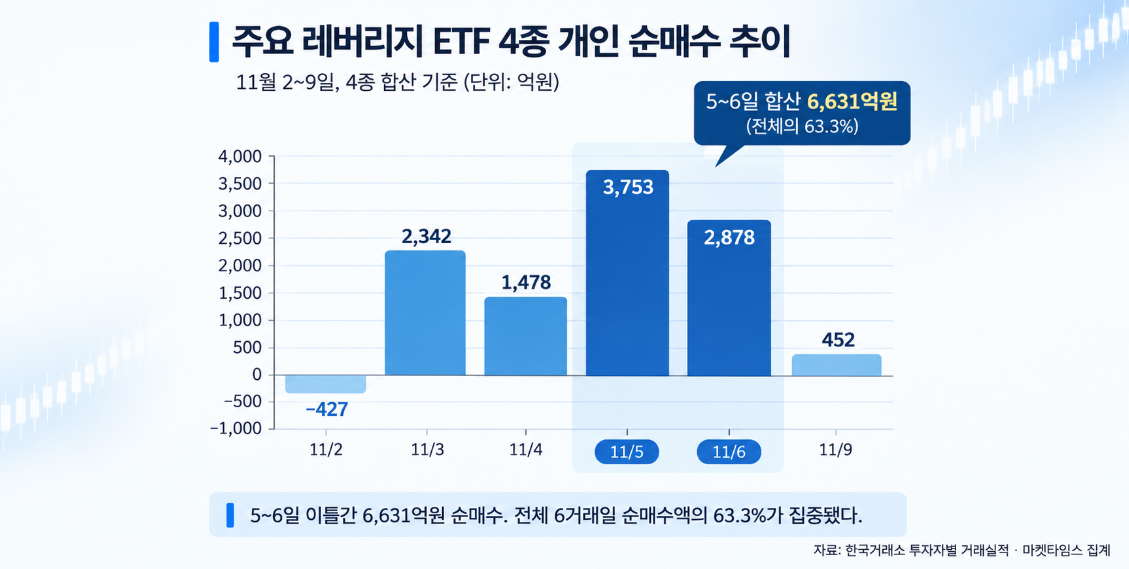 While the buying spree peaked on November 5-6, it proved short-lived. By November 9, the combined net buying for the four products dropped to 45.2 billion won, and the two semiconductor-related leveraged ETFs shifted to net selling.
Forced Liquidations Top 5 Trillion Won; A Cross-Current of Selling and Betting
Parallel to the rebound bets, the market has seen a surge in forced liquidations (ban-dae-mae-mae) due to unpaid margin calls. According to Korea Financial Investment Association data, forced liquidations totaled 5.1903 trillion won between January 2 and November 6, with 2.1156 trillion won occurring in June and July alone.
Forced liquidation occurs when brokerage firms sell off a client's holdings because they failed to meet settlement obligations. While distinct from the leveraged ETF buying, both phenomena highlight the extreme volatility currently gripping the market.
Leveraged ETFs are designed to track a multiple of the daily return of an underlying index. Consequently, cumulative returns over multiple days can deviate significantly from the index's performance due to the effects of compounding. For instance, if an index falls 10% and then rises 11.1%, it returns to its original level; however, a 2x leveraged product would still show a cumulative loss of approximately 2.2%.
While buying leveraged ETFs during a downturn is a strategic bet on a swift recovery, investors face the risk that even if the market eventually rebounds, the path of volatility may erode the value of their holdings, making it difficult to recoup losses.