Revenue surges 168% with a $132.5 billion order backlog driven by long-term AI contracts.
Massive upfront investment in data center construction is being financed through customer prepayments.
U.S. AI cloud provider CoreWeave has reported a significant net loss despite more than doubling its revenue. While AI firms are scrambling to secure computing resources, leading to a surge in orders, the company faces immense capital requirements to build the necessary data centers and procure semiconductors. The cost of expanding infrastructure has become a heavier burden than the pace of customer acquisition.
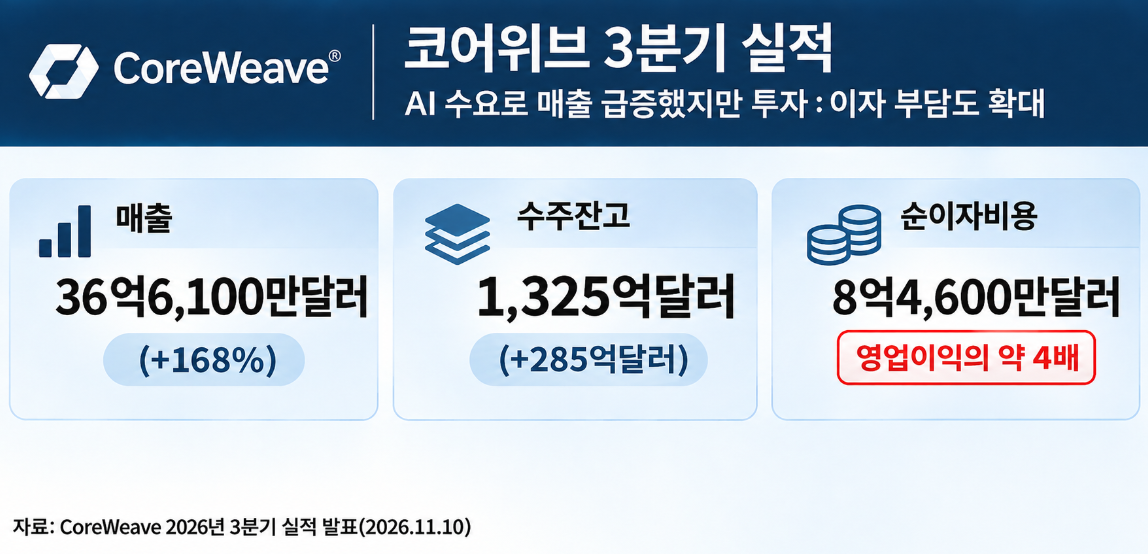
CoreWeave announced on the 10th (local time) that its third-quarter revenue reached $3.661 billion, a 168% increase compared to the same period last year. The results exceeded market expectations, and operating profit grew approximately fourfold. The company also raised its annual revenue guidance to between $13 billion and $13.3 billion.
The backlog for future AI computing services reached $132.5 billion, an increase of $28.5 billion in just three months. As AI firms, including OpenAI, rush to secure long-term computing resources, the scale of CoreWeave's contracts is expanding rapidly.
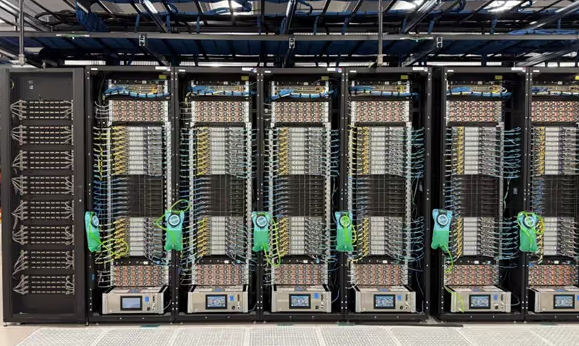
However, CoreWeave cannot provide services immediately upon signing contracts. The company must purchase expensive Nvidia GPUs, construct data centers, and install power and cooling systems. Even when customers reserve computing capacity in advance, CoreWeave must complete the facilities first, with equipment and construction costs incurred well before actual revenue is realized.
Surging Orders Drive Upfront Investment and Debt Burden
In the third quarter, CoreWeave’s cash flow from operations was approximately $2 billion, while $9.8 billion was utilized for investment activities. The company raised approximately $7.4 billion through financing activities during the same period. The capital expenditure forecast for this year alone is $37 billion to $39 billion, roughly three times the expected annual revenue. While investment cash outflows include items beyond facility construction, it is clear that cash generated from operations is insufficient to cover such large-scale investments.
As the company relies on external funding to expand its facilities, financial costs have also ballooned. While third-quarter operating profit rose to $207 million—about four times higher than the previous year—net interest expenses reached $846 million. Consequently, the net loss widened from $110 million last year to $709 million this year. During a period where revenue grew by 168%, the net loss increased more than sixfold.
Despite this, CoreWeave’s stock rose approximately 5% in after-hours trading following the earnings release. The positive sentiment is attributed to revenue beating market expectations, a smaller-than-expected loss per share, an expanding order backlog, and upwardly revised annual revenue guidance.
The company is leveraging its long-term customer contracts to fund its rising investment costs, either by receiving prepayments for future AI services or by using these contracts as a basis for financing. CEO Michael Intrator stated during the earnings call that operating cash flow, customer prepayments, and contract-based financing would serve as the primary sources of investment capital. The company expects approximately $9 billion in customer prepayments and deposits to flow in over the next three months.
While these funds may alleviate some of the pressure for additional borrowing, facility investments to supply the promised computing resources will continue. CoreWeave has secured over 4.6GW of power capacity, while its currently operational capacity is approximately 1.7GW. The company plans to increase operational power to over 1.85GW by the end of the year.
As AI firms continue to preemptively secure long-term computing resources, CoreWeave’s backlog has reached $132.5 billion. However, converting these contracts into actual revenue requires the continued acquisition of GPUs and the expansion of data centers. With its annual revenue forecast raised, CoreWeave is expected to continue large-scale capital expenditures next year, and the timing of funding and new data center operations will be critical factors for future performance.