
South Korean government demands that total tariffs, including new overcapacity levies, remain within a 15% cap following July bilateral consultations.
For items currently subject to a 12.5% rate, an increase to 15% would raise customs duties by $250 per $10,000 of customs value.
The United States is expected to release its findings on manufacturing overcapacity across 16 economies, including South Korea, along with a proposal for additional tariffs as early as this week. South Korean exporters are closely watching whether products currently subject to a 12.5% tariff since July will be included in the new measures, and if so, whether the total tax rate will remain within the 15% threshold agreed upon by Seoul and Washington. The Office of the United States Trade Representative (USTR) has yet to disclose the specific tariff rates or the items subject to the new measures.
The Wall Street Journal reported on the 24th (local time), citing multiple sources, that the USTR could announce the results as early as this week. The report noted that if the U.S. respects existing trade agreements, it may apply tariffs of 15% or less to South Korea, Japan, and the European Union (EU), while potentially imposing higher rates on countries like India and Vietnam. A source interviewed by Reuters on the same day also predicted that the U.S. would honor the 15% ceiling previously agreed upon with South Korea, Japan, and the EU.
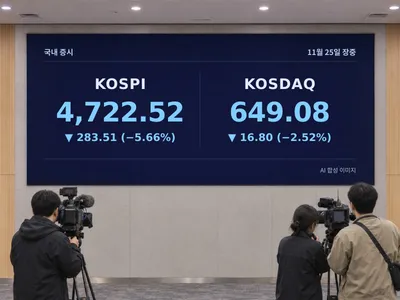
On the 25th, the KOSPI closed at 4,697.51, down 308.52 points (6.16%) from the previous trading day, driven by a sharp decline in U.S. semiconductor stocks. The prospect of additional U.S. tariffs further weighed on investor sentiment.
The investigation stems from a U.S. Supreme Court ruling last February. Following the invalidation of reciprocal tariffs by country, the U.S. launched two investigations in March under Section 301 of the Trade Act. One focused on whether trading partners are effectively blocking imports of goods produced through forced labor, while the other examined whether government subsidies and excess production capacity are harming U.S. industries.
The forced labor investigation resulted in earlier tariff determinations. According to measures announced by the USTR on July 23, if the existing tariff rate on a South Korean product is lower than 12.5%, a Section 301 tariff is applied to cover the difference. If the existing rate is 12.5% or higher, no additional tariff is applied under this measure. According to the Ministry of Trade, Industry and Energy, the South Korean government requested during July trade talks that even with the inclusion of overcapacity tariffs, the total rate should not exceed the 15% agreed-upon limit. The U.S. side reaffirmed the principle that existing trade agreements must be upheld.
For instance, a South Korean product with a customs value of $10,000 currently subject to a 12.5% rate incurs $1,250 in duties. If this product is included in the new tariff scheme and the total rate rises to 15%, the duty would increase by $250 to $1,500. Certain items, such as automobiles, steel, and semiconductors already subject to tariffs under Section 232 of the Trade Expansion Act, as well as some raw materials, were excluded from the July measures. For current 12.5% tariff items, the maximum increase would be 2.5 percentage points if the 15% cap is maintained. Whether products excluded from the July measures will receive similar exemptions remains to be seen.
One of the reasons the U.S. included South Korea in the investigation is its trade surplus. In its March announcement, the USTR stated that South Korea’s goods trade surplus with the U.S. grew to $56 billion in 2024 and reached approximately $49 billion in 2025. It cited electronics, automobiles and parts, machinery, steel, and ships as the sectors driving this surplus. The specific items subject to tariffs will be confirmed in the upcoming announcement.
The USTR specifically noted in its announcement that the South Korean government has acknowledged the need to reduce production capacity in the petrochemical sector. In a submission to the U.S. in April, the South Korean government explained that its petrochemical and steel industries are voluntarily pursuing restructuring to address oversupply. A case in point is the business reorganization plan for the Daesan complex in South Chungcheong Province, approved by the Ministry of Trade, Industry and Energy on February 23. This plan involves the integration of Lotte Chemical and HD Hyundai Chemical’s Daesan facilities and the suspension of Lotte Chemical’s 1.1 million-ton annual ethylene production capacity for three years.
A key variable for Korean firms is whether the U.S. will reflect these capacity reduction efforts in future tariff rates. Ryan Majerus, a former U.S. Department of Commerce trade official, explained to Reuters that the U.S. might adopt a strategy of applying lower initial rates and then phasing in higher tariffs if trading partners fail to reduce excess capacity. It is not yet known whether the USTR will apply such conditions to South Korea.