
MSD-licensed efinepegdutide achieves 63% MASH resolution and 52% fibrosis improvement in the 7mg group
The 4mg dose also shows statistical significance over placebo in both endpoints; researchers highlight 7mg for optimal benefit-risk balance
Hanmi Pharmaceutical has unveiled clinical evidence suggesting that "efinepegdutide," a metabolic dysfunction-associated steatohepatitis (MASH) treatment candidate licensed to Merck & Co. (MSD), can improve steatohepatitis and liver fibrosis in addition to reducing hepatic fat. The findings, confirmed through biopsy, validate the drug's impact on tissue improvement—a core objective in MASH therapeutics.
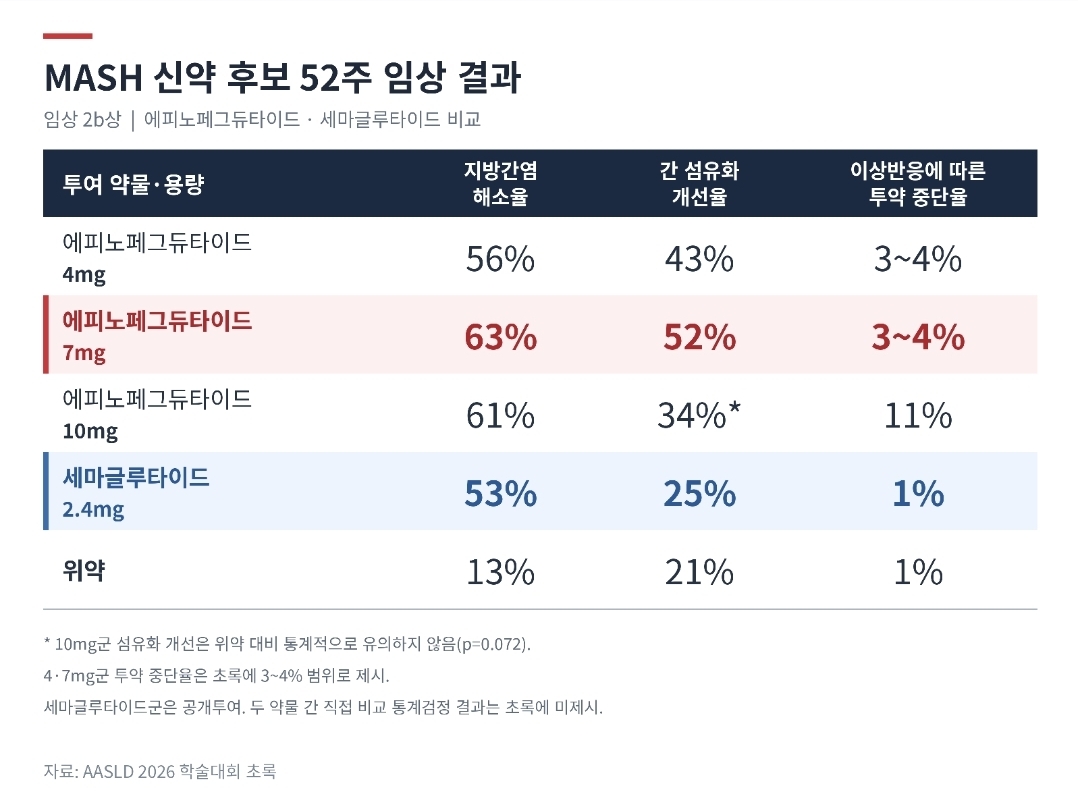
According to the latest research abstracts released from the American Association for the Study of Liver Diseases (AASLD), the proportion of patients in the 7mg cohort who achieved MASH resolution on biopsy without worsening of liver fibrosis at 52 weeks reached 63%, nearly five times that of the placebo group (13%). Furthermore, the proportion of patients who achieved an improvement in liver fibrosis of at least one stage without worsening of MASH was 52%, outpacing the placebo group (21%). Both endpoints demonstrated statistically significant differences (each p<0.001).
Moving from Hepatic Fat Reduction to Inflammation and Fibrosis Improvement
MASH is a progressive liver disease characterized by fat accumulation accompanied by inflammation and hepatocellular injury. Persistent damage can lead to fibrosis, the accumulation of scar tissue. Consequently, clinical evaluations must independently verify not only the reduction of liver fat but also the amelioration of inflammation and fibrosis.
Efinepegdutide is a dual agonist targeting both GLP-1 receptors, which are involved in appetite and blood glucose regulation, and glucagon receptors, which regulate hepatic lipid metabolism. In Phase 2a results announced in 2023, the relative reduction in liver fat content after 24 weeks was 72.7%, compared to 42.3% for the semaglutide (the active ingredient in Wegovy and Ozempic) cohort. The comparator doses evaluated at the time were 10mg of efinepegdutide and 1mg of semaglutide.
The latest Phase 2b trial evaluated improvements in MASH and liver fibrosis via biopsies involving 381 adults with biopsy-confirmed MASH and stage 2-3 liver fibrosis. Fibrosis is staged from 0 to 4, with stage 4 corresponding to cirrhosis.
Participants were randomized into five arms to receive once-weekly injections of efinepegdutide (4mg, 7mg, or 10mg), semaglutide (2.4mg), or a placebo. Researchers assessed efficacy based on liver biopsy results at week 52, with the number of patients analyzed per endpoint varying depending on re-readings of baseline biopsies.
Higher Response Rates Than Competitor, Though Direct Superiority Premature
In the semaglutide 2.4mg arm, the MASH resolution and fibrosis improvement rates were 53% and 25%, respectively. The 2.4mg dose is the once-weekly maintenance dosage recommended for treating MASH in the United States. The efinepegdutide 7mg group posted numerically higher response rates across both endpoints.
However, analysts caution that this does not constitute definitive proof of superiority over the competing drug. The semaglutide arm was conducted in an open-label format, where both physicians and patients were aware of the treatment administered. Additionally, the abstract did not present statistical testing results for a direct head-to-head comparison between the two agents.
Dose-Dependent Efficacy and Adverse Events
Efficacy was not confined to the 7mg dose alone. The 4mg group also demonstrated statistically significant superiority over placebo in both metrics, with a 56% MASH resolution rate and a 43% fibrosis improvement rate.
In the highest-dose cohort (10mg), the MASH resolution rate was 61%—statistically significant compared to placebo—but the fibrosis improvement rate stood at 34%, falling short of statistical significance against the placebo group (21%) (p=0.072).
Adverse events varied by dosage. Gastrointestinal side effects were most frequently reported in the 10mg cohort. Treatment discontinuation rates due to adverse events reached 11% in the 10mg group, higher than those in other efinepegdutide dosage groups (3-4%) and the placebo and semaglutide groups (1% each).
Synthesizing these results, the 7mg cohort exhibited the numerically highest response rates across both primary endpoints while maintaining a lower discontinuation rate due to adverse events than the 10mg group. Researchers noted in the abstract that the 7mg dose offers the most favorable benefit-risk profile among the dosages tested.
Adding Tissue Improvement Evidence to a Licensed Asset
MSD and Hanmi Pharmaceutical announced an exclusive licensing agreement for the development, manufacturing, and commercialization of efinepegdutide on August 4, 2020. The pact included an upfront payment of $10 million, up to $860 million in milestone payments spanning development, regulatory approval, and commercialization, alongside double-digit royalties on sales of approved products. Under the terms, Hanmi Pharmaceutical retained an option to commercialize the drug in South Korea.
Future milestone payouts to Hanmi are contingent upon meeting contractual conditions throughout the development, regulatory, and commercialization phases. This Phase 2b trial reinforces the candidate's scientific rationale by demonstrating its capacity to mitigate not only hepatic fat but also steatohepatitis and fibrosis. Data regarding dose-dependent efficacy and adverse events are expected to serve as a critical foundation for MSD in selecting the optimal dose for subsequent clinical trials.